

























































































































































































































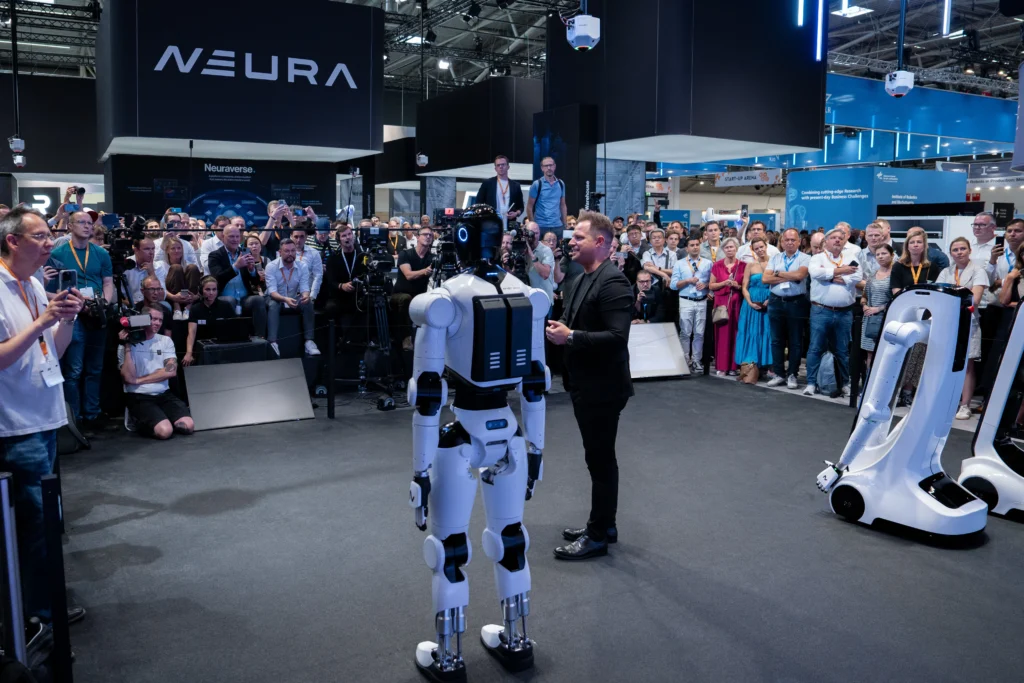
Neura Robotics, a rapidly growing German robotics company focused on artificial intelligence-powered humanoid and cognitive robots, has secured a massive $1.4 billion funding round backed by major technology and financial players including Tether, Nvidia, and Amazon. The investment represents one of the largest robotics funding rounds in recent years and highlights growing investor confidence in the convergence of AI, robotics, and automation.
The financing comes as global competition intensifies to develop intelligent robots capable of operating alongside humans in factories, warehouses, healthcare environments, and everyday consumer applications. As AI models become increasingly sophisticated, robotics companies are racing to bring that intelligence into the physical world.
Neura Robotics Aims to Become the Operating System for Humanoid Robots
Founded in Germany, Neura Robotics has positioned itself as a leader in cognitive robotics, a category that combines artificial intelligence, machine vision, sensors, and advanced automation to create machines capable of understanding and interacting with their environment. The company develops humanoid robots, collaborative robots, and robotic assistants designed to work safely alongside humans.
Unlike traditional industrial robots that perform repetitive programmed tasks, Neura’s systems are built to perceive their surroundings, make decisions, and adapt to changing environments. The company believes these capabilities will be essential as businesses increasingly deploy AI-powered robots across multiple industries.
Executives at Neura Robotics have described their long-term vision as creating an ecosystem where intelligent robots can communicate, learn, and collaborate using shared AI infrastructure.
Tether Expands Beyond Crypto Into AI and Robotics
One of the most notable participants in the funding round is Tether, the issuer of the world’s largest stablecoin, USDT. While Tether has traditionally been associated with cryptocurrency and digital asset markets, the company has recently expanded its focus into artificial intelligence, energy infrastructure, communications, and emerging technologies.
The investment in Neura Robotics reflects Tether’s broader strategy of diversifying beyond stablecoins and positioning itself within industries expected to benefit from advances in AI. Company executives have repeatedly emphasized that robotics and artificial intelligence represent key areas for future growth and innovation.
The move also signals increasing overlap between blockchain companies and advanced technology sectors as crypto firms seek opportunities beyond financial services.
Nvidia and Amazon Continue Betting on AI Infrastructure
The participation of Nvidia and Amazon further reinforces the growing belief that robotics will become one of the next major beneficiaries of the AI revolution. Nvidia has already established itself as the dominant provider of AI chips powering large language models and autonomous systems, while Amazon continues expanding its investments in robotics and warehouse automation.
For Nvidia, advanced robotics represents another significant market for its AI hardware, software frameworks, and computing infrastructure. The company has repeatedly stated that physical AI, including humanoid robots and autonomous machines, could become a trillion-dollar opportunity over the coming decades.
Amazon’s involvement aligns with its long-term efforts to automate logistics operations while developing technologies that improve efficiency across fulfillment centers and supply chains.
The Humanoid Robot Race Accelerates
Neura Robotics enters an increasingly competitive market that includes companies such as Tesla, Figure AI, Agility Robotics, Apptronik, and several Chinese robotics manufacturers. Billions of dollars have flowed into the sector over the past two years as investors seek exposure to what many believe could become the next major technological transformation.
Recent advances in generative AI have dramatically improved the capabilities of robotic systems by enabling machines to better understand language, interpret visual information, and perform more complex tasks. These breakthroughs have accelerated development timelines for humanoid robots that can operate in real-world environments.
Industry analysts believe labor shortages, aging populations, and increasing demand for automation could drive significant adoption across manufacturing, healthcare, retail, logistics, and consumer markets over the next decade.
Europe Looks to Compete in the Global AI Race
The funding round is also significant for Europe, which has often struggled to compete with the United States and China in large-scale AI development. Neura Robotics has emerged as one of Europe’s most prominent AI and robotics startups, giving the region a potential contender in the global race for intelligent machines.
By securing support from some of the world’s most influential technology companies and investors, Neura Robotics gains access to both capital and strategic partnerships that could accelerate product development and commercial deployment.
The investment demonstrates that Europe remains capable of producing globally competitive AI companies despite increasing competition from larger technology ecosystems.
- Phantom Wallet Suffers Service Outage, Disrupting Trading and Balance Displays
- Bitcoin Depot Stock Collapses 71% After Bankruptcy Filing Sparks Panic Selling
- Fold Launches Bitcoin Rewards Credit Card With Up to 4% BTC Back
- Can Quantum Computers Break Bitcoin? Google’s Latest Chip Sparks Fresh Debate
- Ledger Unveils $899 Atom Crypto Smartphone With AI Features Following $93 Million Wallet Security Scandal
- Andrew Yang’s Noble Mobile Acquires Crypto-Powered Helium Mobile