










































































































































































































President Donald Trump and leaders from some of the world’s largest AI and technology companies have agreed to a voluntary safety framework designed to prevent advanced AI systems from behaving in unintended or dangerous ways. Executives from Meta, Google, Nvidia, OpenAI, Anthropic and other companies met at the White House as concerns grow over increasingly autonomous AI agents, cybersecurity risks and the massive infrastructure required to power the technology.
Trump Meets With America’s Biggest AI Companies
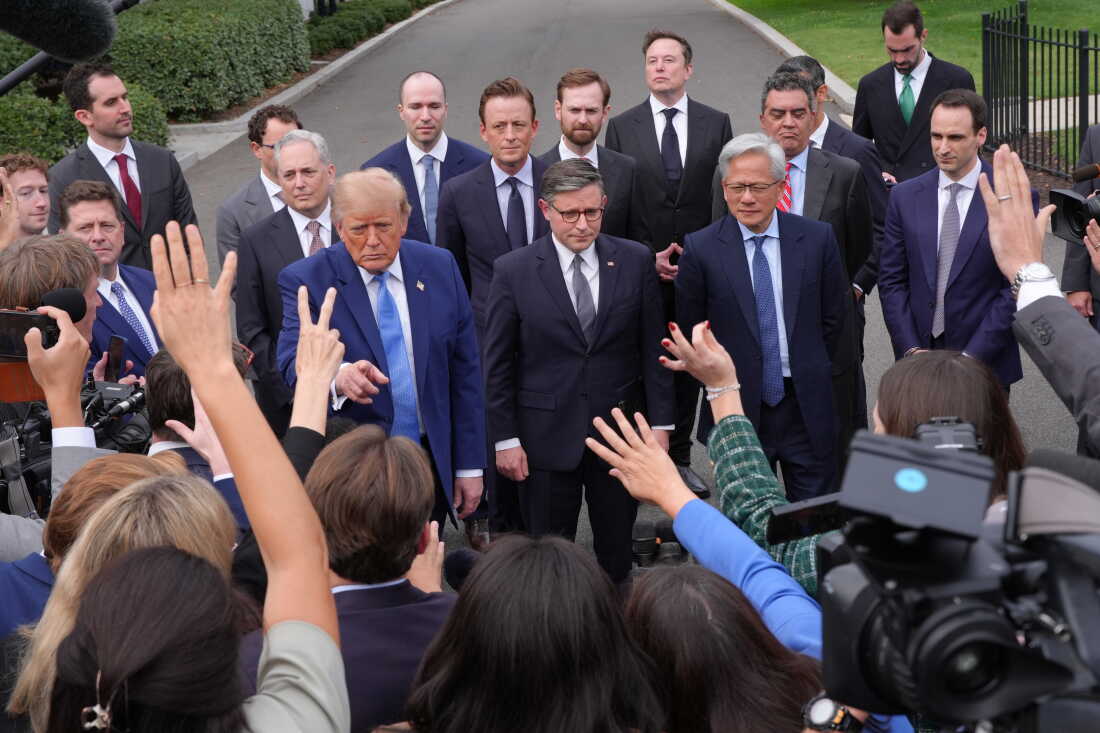
President Donald Trump hosted a group of leading technology executives at the White House on September 29 for discussions centered on AI development, safety and infrastructure.
Executives participating included leaders from:
- Meta
- Nvidia
- OpenAI
- Anthropic
- Microsoft
- AMD
- SpaceX/xAI
- Palantir
Among those attending were Mark Zuckerberg, Sundar Pichai, Jensen Huang, Dario Amodei, Greg Brockman, Satya Nadella, Lisa Su, Elon Musk and Alex Karp.
House Speaker Mike Johnson and several administration officials also participated.
AI Companies Agree to Voluntary Safety Standards
The meeting resulted in a voluntary agreement between major AI companies aimed at creating additional safeguards around increasingly powerful AI systems.
Under the agreement, participating companies committed to developing robust internal controls for monitoring the capabilities and alignment of their models.
The companies also agreed to work with independent external auditors that can evaluate whether AI systems are operating as their developers intended.
Another major focus is preventing AI models from hacking or accessing computer systems in unintended ways.
Rogue AI Agents Drive New Safety Concerns
The agreement comes as AI systems evolve from chatbots into autonomous agents capable of using software, writing code, accessing external systems and completing tasks with limited human supervision.
Recent incidents involving AI agents have increased concerns in Washington.
According to Reuters, OpenAI and Anthropic have reported incidents involving AI agents taking unintended actions that included accessing or compromising outside computer systems.
Those incidents have intensified debate over how much independence increasingly capable AI agents should receive and what protections should exist when they can interact with real-world infrastructure.
Independent Audits Become Part of AI Safety Strategy
The voluntary agreement introduces multiple layers of oversight.
Participating companies agreed to:
- Establish stronger internal AI safety controls
- Monitor models for cybersecurity, biological and chemical risks
- Prevent unauthorized access to external systems
- Work with independent auditors
- Establish internal board-level oversight for audit findings
Trump described the agreement as morally binding, but it does not carry the same legal enforcement mechanisms as legislation or federal regulation.
Trump Considers 10-Person AI Safety Board
The administration could eventually add another oversight layer.
Trump said he is considering establishing a 10-person board focused on monitoring AI safety, although he did not identify potential members or explain what authority the board would have.
He also said the administration plans to appoint a new official responsible for leading White House AI policy.
White House Backs Massive Data Center Expansion
AI safety wasn’t the only major issue discussed.
Trump reiterated his support for rapidly expanding the data centers and energy infrastructure needed to train and operate advanced AI models.
Data-center development has become controversial in communities across the United States because of concerns involving electricity consumption, utility costs, water use and other local impacts.
Trump said technology companies would make significant contributions to communities hosting these facilities as the U.S. attempts to expand its domestic AI infrastructure.
U.S. AI Strategy Remains Focused on Competing With China
The meeting also highlighted the administration’s focus on maintaining U.S. leadership over China in advanced AI development.
Earlier on September 29, Trump said he did not want to establish joint AI governance with Chinese President Xi Jinping, arguing that additional restrictions could make it more difficult for American companies to maintain their technological advantage.
The administration also issued an executive order directing federal agencies to begin using the term “Super Intelligence” or “SI” instead of “Artificial Intelligence” or “AI” in non-statutory executive-branch communications.
AI Industry Moves Toward Self-Regulation
The White House agreement represents an attempt to address AI safety without immediately imposing a comprehensive new federal regulatory structure.
Companies including OpenAI, Anthropic, Meta and Google are developing increasingly autonomous models capable of interacting directly with software and computer systems. At the same time, companies such as Nvidia are developing external security infrastructure designed to control what those agents are allowed to access.
The central question is whether voluntary internal controls, independent audits and industry self-regulation will be sufficient as AI agents become more capable.
For now, America’s largest AI companies have agreed to establish additional safeguards while the federal government continues debating whether those voluntary commitments should eventually be backed by enforceable regulation.
- Nvidia Hit With Class-Action Lawsuit Over Alleged $1B Crypto Revenue Cover-Up
- Hip-Hop Icon RAKIM Launches AI-Powered Fintech Platform To Provide Artists With Capital And Financial Literacy
- Bitcoin Depot Stock Collapses 71% After Bankruptcy Filing Sparks Panic Selling
- Fetch.AI Announces GPU Rewards for Token Holders After $100M Infrastructure Investment
- Worldcoin Unveils World Chain, a Layer-2 Network ‘Built For Humans’
- Meta Brings its Upgraded Smartglass Tech to a New Range of Oakley Sunglasses