



































































































































































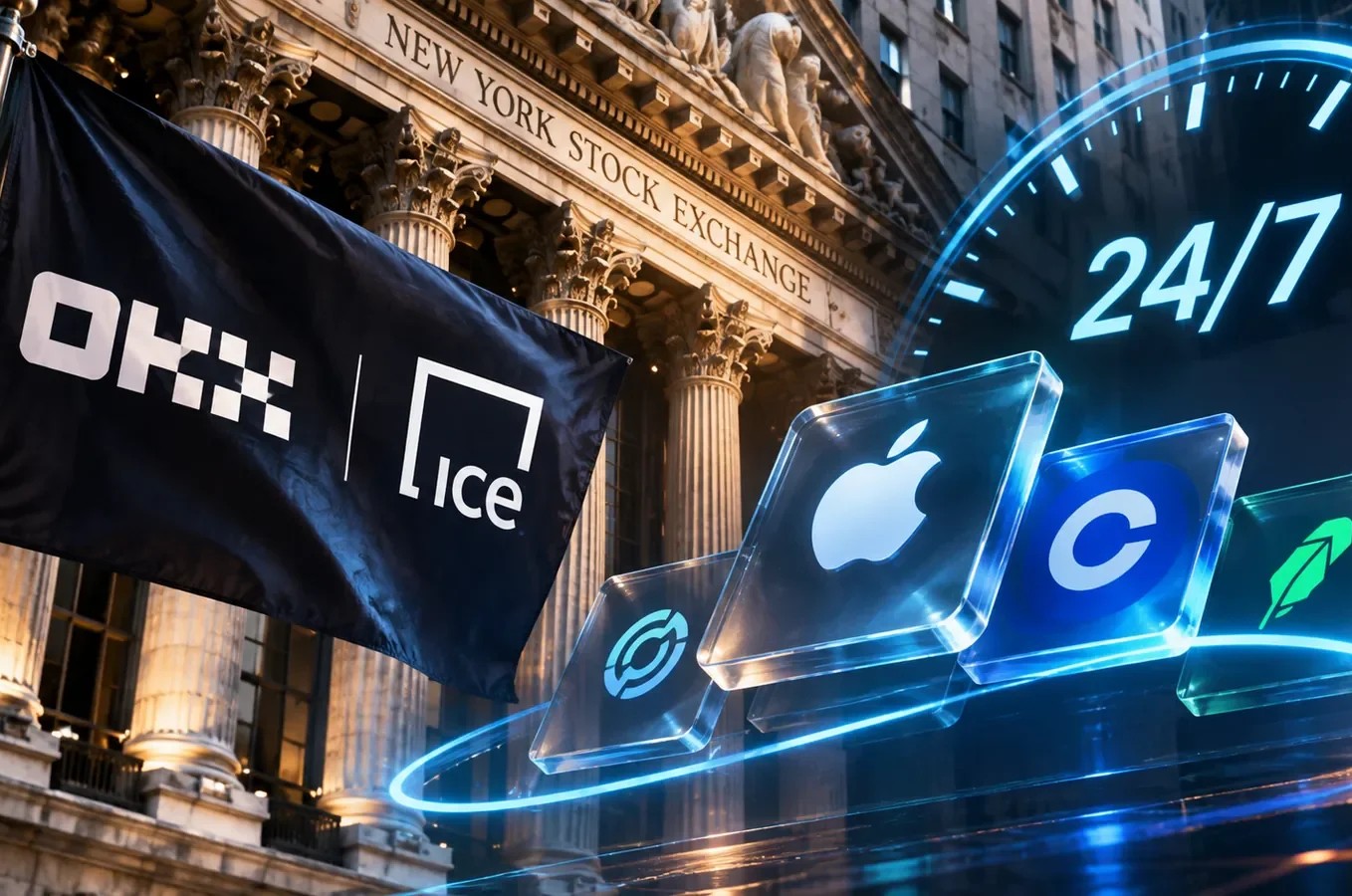
Cryptocurrency exchange OKX and Intercontinental Exchange (ICE), the parent company of the New York Stock Exchange (NYSE), have announced a November 23 launch date for their blockchain-based tokenized securities platform, OKXICE, with more than 70 stocks and exchange-traded funds expected to be offered. The new venue will initially feature cryptocurrency-friendly companies including Coinbase, Circle, Robinhood, Strategy, BitGo, Securitize and Better.com, alongside 59 exchange-traded funds from Direxion. The announcement follows significant resistance from traditional corporate America, with 67 companies, including Apple, Microsoft, Nvidia, Amazon, Alphabet, Meta and Tesla, formally objecting to having their shares traded on the platform. Built on OKX’s X Layer blockchain, the venue will use Uniswap v4 automated market makers and tokenization infrastructure from Securitize to support 24/7 trading and self-custody. The launch represents a major test of the SEC’s five-year innovation exemption, which allows qualifying blockchain securities platforms to operate under a specialized regulatory framework while giving publicly traded companies the right to reject unauthorized tokenized versions of their shares.
OKXICE Announces November 23 Launch Following Months of Preparation
The joint venture between OKX and Intercontinental Exchange confirmed that its Tokenized Securities Venue (TSV) is scheduled to begin operating on November 23, 2026.
The platform aims to provide eligible U.S. investors with access to tokenized versions of publicly traded securities through the OKX application.
Unlike traditional stock exchanges, which operate within established trading sessions, OKXICE plans to support continuous trading using blockchain-based infrastructure.
The platform will combine regulated securities arrangements with decentralized trading technology.
Its initial offering includes more than 70 tokenized securities, although company representatives clarified that not every announced asset will necessarily be available on the first day.
Key details of the planned launch include:
Launch date: November 23, 2026.
Joint venture partners: OKX and NYSE parent Intercontinental Exchange.
Initial asset lineup: More than 70 stocks and ETFs.
ETF participation: 59 exchange-traded funds from Direxion.
Blockchain network: X Layer, OKX’s Ethereum Layer 2.
Trading infrastructure: Uniswap v4 automated market maker pools.
Tokenization provider: Securitize.
Trading availability: Designed for 24-hour, seven-day-a-week operation.
Eligible users: Qualified U.S.-based OKX customers who complete the required verification and onboarding.
The announcement establishes a clearer launch timeline for a project that has attracted considerable attention from both cryptocurrency companies and traditional financial institutions.
However, the November 23 date remains a scheduled launch rather than confirmation that trading has already begun.
Coinbase, Circle and Strategy Lead the Initial Stock Listings
After facing opposition from many of America’s largest corporations, OKXICE has secured an initial lineup heavily concentrated in companies already connected to cryptocurrency and digital assets.
The companies expected to participate include:
| Company | Business focus |
|---|---|
| Coinbase (COIN) | Cryptocurrency exchange and institutional custody |
| Circle (CRCL) | USDC stablecoin issuer |
| Robinhood (HOOD) | Retail brokerage and cryptocurrency trading |
| Strategy (MSTR) | Bitcoin-focused corporate treasury |
| BitGo (BTGO) | Digital asset custody and infrastructure |
| Securitize (SECZ) | Tokenization and digital securities infrastructure |
| Better.com | Digital mortgage and financial technology services |
The lineup reflects a practical shift in the venture’s strategy.
Rather than beginning with a broad selection of traditional technology, banking and industrial companies, OKXICE will initially focus on businesses with existing exposure to cryptocurrency or financial technology.
These companies may be more comfortable participating in experimental blockchain-based securities markets because their businesses already operate within the digital asset ecosystem.
Strategy, the Bitcoin treasury company formerly known as MicroStrategy, is expected to offer both its common shares and preferred securities.
Strategy CEO Phong Le described tokenization as a natural extension of the company’s approach to financial innovation.
The inclusion of Strategy’s preferred shares is particularly notable because tokenization could eventually provide additional trading options for different types of equity securities.
However, the actual availability of each instrument will depend on the venue’s final launch arrangements.
Direxion Adds 59 ETFs to Expand Trading Beyond Crypto Stocks
One of the most significant additions to the OKXICE platform is Direxion, an asset manager specializing in exchange-traded funds.
Direxion plans to make 59 ETFs available through the tokenized securities venue.
The company manages approximately $70 billion in assets, according to the announcement.
Its participation broadens the platform beyond individual cryptocurrency-related stocks.
ETFs allow investors to gain exposure to baskets of securities, market indexes, sectors or investment strategies through a single investment product.
Direxion is particularly known for leveraged and inverse ETFs, which are designed to deliver specific multiples of daily market performance or move in the opposite direction of an underlying benchmark.
These products can involve significant risks, especially when held for periods longer than their intended daily investment horizon.
Tokenization does not change those underlying investment characteristics.
A tokenized leveraged ETF would still carry the market, leverage and compounding risks associated with the original financial product.
Direxion CEO Douglas Yones described the company’s participation as part of its effort to deliver investment products through evolving trading infrastructure.
For OKXICE, the ETF partnership provides a substantial portion of its announced initial asset lineup.
It also demonstrates that tokenized securities platforms may expand through relationships with willing asset managers even when individual corporations decline participation.
Apple, Microsoft, Nvidia and Tesla Reject Tokenized Stock Listings
The November 23 launch announcement follows several weeks of opposition from publicly traded companies.
As of the venue’s November 5 disclosure, 67 companies had formally objected to having their shares represented through third-party tokens on OKXICE.
The list includes all seven companies commonly referred to as the Magnificent Seven:
Apple (AAPL)
Microsoft (MSFT)
Nvidia (NVDA)
Amazon (AMZN)
Alphabet (GOOGL)
Meta Platforms (META)
Tesla (TSLA)
Other companies that objected include JPMorgan Chase, Home Depot, Boeing, Palantir, ServiceNow, S&P Global, KLA, Super Micro Computer and GE Vernova.
The objections significantly reduced the range of traditional securities that OKXICE originally hoped to offer.
According to CoinDesk’s analysis, 56 of the 62 companies in the venue’s original selection had objected, representing approximately 90% of the initial group.
The remaining objections involved companies outside that original selection.
This widespread resistance illustrates the uncertainty surrounding third-party tokenization of publicly traded securities.
Importantly, the objections do not necessarily mean that these companies oppose blockchain technology or tokenized securities in general.
They specifically prevent the OKXICE venue from offering unaffiliated tokenized versions of their shares under the applicable regulatory framework.
A company could still pursue a separate tokenization initiative through another approved platform or infrastructure provider.
Why Major Corporations Are Rejecting Tokenized Stocks
The growing number of objections highlights a fundamental question facing the tokenized securities industry: Who should control how a company’s shares are represented and traded on blockchain networks?
Traditional public companies operate within established securities markets where exchanges, broker-dealers, transfer agents and clearinghouses perform clearly defined roles.
Third-party tokenization introduces another layer of infrastructure.
A separate company may purchase or custody existing shares and issue blockchain tokens representing financial entitlements connected to those securities.
Although these tokens can be designed to preserve shareholder rights, issuers may have concerns about how the products are structured, distributed and marketed.
Potential issues include:
Shareholder rights: Whether token holders receive the same dividends, voting privileges and corporate action benefits as conventional shareholders.
Ownership records: How blockchain-based holdings connect to legally recognized securities ownership.
Market surveillance: Whether tokenized trading venues can adequately monitor manipulation and suspicious transactions.
Investor protection: How disputes, operational failures and custody issues would be handled.
Regulatory responsibility: Which entities are accountable for compliance and disclosure obligations.
Corporate control: Whether issuers should have a direct role in approving tokenized representations of their securities.
These are important considerations, but individual companies have not necessarily provided detailed public explanations for their objections.
Therefore, the objections should not automatically be attributed to any one concern.
The broader issue is that tokenized securities infrastructure is developing faster than many traditional corporations are prepared to adopt it.
SEC Innovation Exemption Gives Companies 30 Days to Object
The OKXICE platform is being developed under the Securities and Exchange Commission’s five-year innovation exemption, introduced in September 2026.
The framework allows qualifying securities trading venues to experiment with blockchain-based trading and settlement arrangements under specified conditions.
One of its most important features is a formal objection process for publicly traded companies.
When a third party seeks to tokenize a company’s shares without being directly affiliated with the issuer, the company must receive notice.
The issuer then has 30 calendar days to object.
If the company submits a timely objection, the venue cannot proceed with trading that third-party tokenized version of its stock.
The process generally follows these steps:
Issuer notification: The tokenization venue notifies a company that it intends to offer a tokenized version of its shares.
Review period: The company receives 30 calendar days to evaluate the proposal.
Formal objection: The issuer may submit written opposition within the designated period.
Listing restriction: A timely objection prevents that venue from listing the proposed third-party tokenized security.
Alternative arrangements: The company may still explore other tokenization initiatives under applicable rules.
The framework attempts to balance financial innovation with the rights and interests of publicly traded companies.
It also creates an important distinction between issuer-sponsored tokenization and products created by unaffiliated third parties.
For OKXICE, the exemption provides a regulatory pathway to launch its venue while requiring it to respect objections from issuers.
OKXICE Will Use Uniswap v4 Instead of Traditional Stock Order Books
One of the most distinctive features of the planned platform is its use of Uniswap v4 automated market maker technology.
Traditional stock exchanges typically match buyers and sellers through order books.
These systems organize bids and offers based on price and other execution rules.
An automated market maker (AMM) uses liquidity pools and programmed trading mechanisms to facilitate transactions.
Rather than requiring every trade to match directly with another investor’s order, the system allows participants to trade against available liquidity in a pool.
OKXICE plans to use permissioned liquidity pools built on Uniswap v4, operating through X Layer, OKX’s Ethereum Layer 2 network.
This approach combines elements of decentralized finance with regulated securities trading.
The platform is designed to support continuous trading while maintaining eligibility and compliance requirements for participants.
Potential advantages include:
Continuous market access: Trading infrastructure designed to operate beyond conventional stock exchange hours.
Programmable execution: Smart contracts can automate portions of the transaction process.
Blockchain settlement: Transactions can be recorded through the underlying network.
Self-custody: Eligible customers can hold their tokenized securities in supported personal wallets.
Transparent transaction records: Blockchain infrastructure can provide verifiable records of token transfers.
However, automated market makers also introduce considerations involving liquidity, slippage and price formation.
A trading venue must ensure that its execution mechanisms operate appropriately for regulated securities.
The success of the model will depend on whether OKXICE can attract sufficient liquidity while maintaining effective compliance and investor protections.
Securitize Will Back Each Token With a Real U.S. Share
Securitize, a major provider of tokenized securities infrastructure, will handle the tokenization process for OKXICE.
According to the announcement, each token will represent a securities entitlement backed one-for-one by an actual U.S. share.
This is an important distinction from synthetic tokens that merely track the price of an underlying stock.
Under the announced structure, the tokens are intended to preserve economic and shareholder benefits associated with the underlying securities.
These include:
Dividend rights: Eligible token holders receive applicable dividend benefits.
Voting rights: Investors retain relevant shareholder voting privileges.
Corporate actions: Token holders can participate in applicable stock splits, mergers and other issuer events.
One-to-one backing: Each token is supported by a corresponding underlying security.
Regulated ownership arrangements: The securities are held through the platform’s approved financial infrastructure.
The structure is designed to connect blockchain-based trading with traditional securities ownership.
However, a tokenized securities entitlement is not necessarily identical in legal form to direct registered ownership of a company’s shares.
The precise rights of investors depend on the applicable custody arrangements, offering documents and regulatory structure.
For investors, understanding those distinctions will be important before trading tokenized securities.
Eligible U.S. Investors Will Hold Tokenized Stocks in Self-Custody Wallets
Unlike traditional brokerage accounts, where securities are commonly held through custodial arrangements, OKXICE plans to support self-custody.
Eligible customers will hold their tokenized securities through wallets they control.
According to the announcement, OKXICE will not retain customers’ assets or private keys.
To access the platform, users must complete several requirements.
Initial eligibility requirements include:
Be an eligible U.S.-based OKX customer.
Activate the required CeDeFi Wallet.
Complete identity verification and applicable compliance checks.
Finish the OKXICE onboarding process.
Use the supported infrastructure for holding and trading tokenized securities.
The term CeDeFi, or centralized decentralized finance, generally describes systems combining elements of regulated centralized financial services with decentralized blockchain technology.
For OKXICE, the model aims to connect securities compliance with self-custodial blockchain trading.
However, self-custody introduces responsibilities that investors may not encounter with conventional brokerage accounts.
Users must protect their wallet credentials and understand the procedures for accessing and transferring their assets.
The ability to hold tokenized securities directly does not eliminate the financial risks associated with the underlying investments.
Andrew Cuomo Says SEC Framework Creates New Opportunity for American Markets
Andrew Cuomo, the former governor of New York and co-chairman of OKXICE, described the SEC’s regulatory framework as an opportunity for American financial markets to lead the development of blockchain-based securities trading.
Cuomo’s involvement reflects the venture’s effort to position tokenization as part of the evolution of U.S. capital markets.
The partnership between OKX and ICE combines two different areas of financial expertise.
OKX brings experience operating cryptocurrency trading infrastructure, digital wallets and blockchain applications.
ICE contributes established relationships and experience in traditional financial markets through its ownership of the NYSE and other financial infrastructure businesses.
The joint venture is attempting to connect these capabilities through a regulated tokenized securities venue.
However, its initial rollout also demonstrates the challenges involved in gaining acceptance from established corporations.
The SEC may provide a regulatory pathway for experimentation, but individual companies still have the ability to reject third-party tokenization of their shares.
This creates a market in which participation depends on both regulatory authorization and corporate willingness.
OKXICE Joins Growing Competition for Tokenized Stock Trading
The November 23 launch is part of a broader movement toward bringing traditional securities onto blockchain networks.
Major financial institutions and cryptocurrency companies are developing different approaches to tokenized stocks, investment funds and settlement infrastructure.
The Depository Trust & Clearing Corporation (DTCC) launched a tokenization service in late October, supporting eligible securities through infrastructure that includes the Canton Network.
Morgan Stanley subsequently announced that it was among the early financial institutions using the service.
Meanwhile, the New York Stock Exchange has selected Avalanche technology for a separate initiative involving blockchain-based securities settlement.
Although both initiatives involve ICE-related financial infrastructure, the NYSE’s Avalanche project and OKXICE are distinct developments.
The industry is exploring several competing models:
| Initiative | Main approach |
|---|---|
| OKXICE | Tokenized stocks and ETFs traded through blockchain-based AMM pools |
| NYSE and Avalanche | Dedicated blockchain infrastructure for tokenized securities settlement |
| DTCC | Tokenization of eligible securities held within established custody infrastructure |
| Canton-based trading venues | Regulated trading and settlement of eligible blockchain securities |
These initiatives demonstrate that tokenization is no longer limited to experimental cryptocurrency projects.
Major financial institutions are increasingly evaluating blockchain technology as a way to modernize securities markets.
However, the competing approaches also show that the industry has not yet established a single dominant model.
Some platforms prioritize self-custody and decentralized trading mechanisms, while others focus on integrating blockchain into existing institutional systems.
Crypto Companies Could Lead the First Wave of Tokenized Stock Adoption
The initial OKXICE lineup suggests that cryptocurrency-related companies may play an important role in establishing early demand for tokenized equities.
Businesses such as Coinbase, Circle, Robinhood and Strategy already operate in markets where blockchain technology and digital assets are central to their strategies.
Their participation could provide a practical starting point for testing how regulated tokenized securities function in live markets.
Meanwhile, traditional technology companies appear more cautious.
The rejection of the platform by all seven Magnificent Seven companies demonstrates that mainstream corporate adoption may require additional regulatory clarity, operational experience and confidence in tokenization infrastructure.
The contrast is significant.
Crypto-native businesses are generally more familiar with blockchain-based financial products, while many traditional corporations may prefer to evaluate the technology before authorizing third-party representations of their securities.
For OKXICE, the initial concentration in cryptocurrency-related stocks could create both opportunities and limitations.
It may attract investors already interested in digital assets, but it could also limit diversification compared with conventional stock exchanges.
The inclusion of Direxion’s 59 ETFs helps broaden the platform’s offerings.
Ultimately, the venue’s growth will depend on whether it can attract investors, maintain liquidity and persuade additional issuers to participate.
November 23 Launch Will Test the Future of Blockchain Stock Markets
The scheduled launch of OKXICE on November 23, 2026, represents an important milestone for regulated tokenized securities trading in the United States.
The platform plans to offer more than 70 tokenized stocks and ETFs, supported by infrastructure from Securitize, Uniswap v4 and OKX’s X Layer blockchain.
Its initial lineup is led by cryptocurrency-related companies, including Coinbase, Circle, Robinhood and Strategy, alongside a substantial selection of Direxion ETFs.
However, the venture has also encountered significant resistance.
With 67 companies formally objecting, including America’s largest technology corporations, the project demonstrates that regulatory permission alone does not guarantee widespread issuer participation.
The SEC’s innovation exemption provides a framework for experimentation while preserving the ability of companies to reject unauthorized third-party tokenization.
For investors, the platform could introduce new ways to trade and hold securities through blockchain-based wallets.
For the financial industry, it will provide a real-world test of whether automated market makers and self-custodial infrastructure can operate effectively within regulated securities markets.
The success of the initiative will depend on trading liquidity, investor participation, regulatory compliance and the willingness of additional companies to embrace tokenization.
OKXICE’s November 23 launch could become a defining moment for blockchain-based stock trading, but the industry’s biggest challenge may not be the technology itself. With major corporations rejecting third-party tokenized shares while crypto-friendly companies move forward, the next phase of Wall Street tokenization will depend on earning the confidence of traditional issuers as much as attracting investors to new digital trading platforms.
- UBS Launches its First Tokenized Fund on Ethereum Blockchain
- Visa Joins Canton Network as Super Validator to Power Institutional Blockchain Payments
- Gold Arrives on ‘Digital Gold’ as Bitcoin Gets Tokenized Version of the Metal
- U.S. Transportation Official Patents Nationwide Road Pricing System Using Hedera Technology
- Tether, Bitfinex, Cantor and SoftBank to Launch ‘21’ a Bitcoin Company With $3.9 Billion Treasury
- Startup Enables Blockchain “Mining” on Quantum Computers for the First Time