






















































































































































































































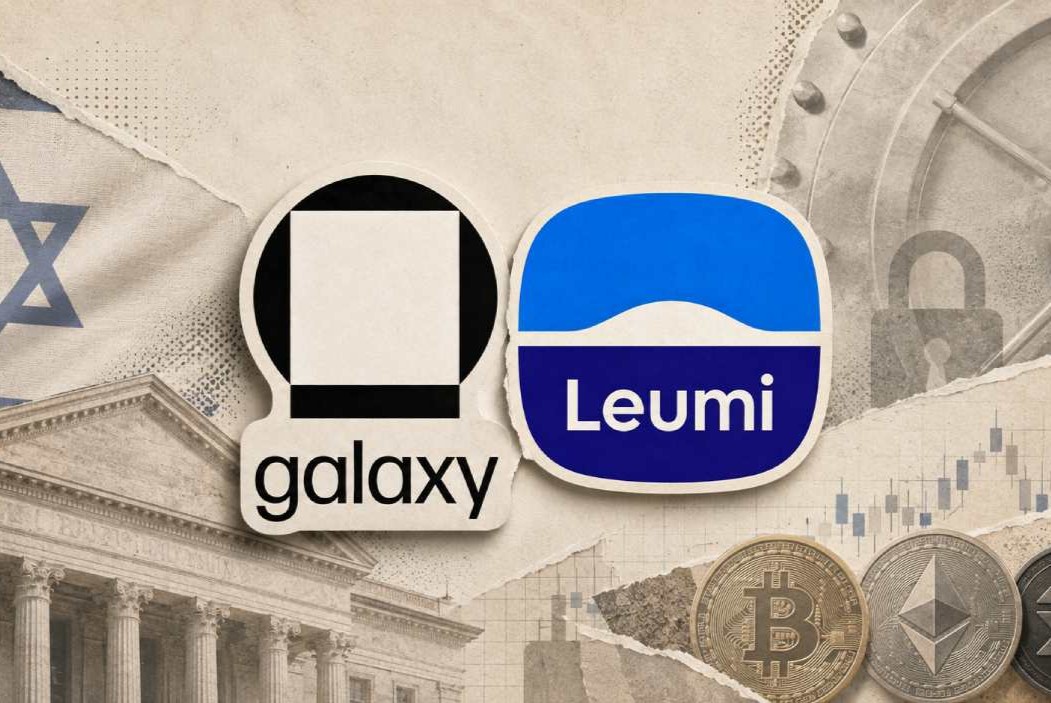
Bank Leumi, Israel’s largest bank, is preparing to offer customers direct access to Bitcoin, Ethereum and Solana trading through its existing investment platform in a major expansion of cryptocurrency services within the country’s traditional banking system. The bank has partnered with Galaxy Digital, which will provide the institutional-grade trading and custody infrastructure behind the service, with a launch targeted for early 2027.
If launched as planned, Bank Leumi says it will become the first Israeli bank to offer digital asset trading directly to customers. Users of both Bank Leumi and its digital banking arm PEPPER will be able to buy, hold and sell supported cryptocurrencies without needing to transfer their money to a separate crypto exchange.
Bitcoin, Ethereum and Solana Come to Leumi Trade
The new service will be integrated into Leumi Trade, the bank’s existing investment platform.
Customers will initially have access to Bitcoin, Ether and Solana, along with other “selected” cryptocurrencies that have not yet been announced.
The significance is the integration with conventional banking infrastructure.
Instead of opening an account with a dedicated cryptocurrency exchange, funding that account, purchasing crypto and managing a separate wallet or custody relationship, eligible Bank Leumi customers will be able to access digital assets through an investment environment they already use.
That brings crypto considerably closer to traditional stocks, bonds and other investments offered through banks and brokerages.
Galaxy Will Handle Crypto Trading and Custody Infrastructure
Bank Leumi isn’t building the underlying cryptocurrency infrastructure entirely on its own.
The bank is partnering with Galaxy, the digital asset and financial services company founded by Mike Novogratz.
Galaxy will provide the institutional trading and custody infrastructure required to support the service.
That division of responsibilities is becoming an increasingly important model for traditional financial institutions entering crypto.
Banks already possess customers, regulatory infrastructure and established financial applications. Crypto-native companies such as Galaxy can provide the specialized trading, custody and blockchain infrastructure needed behind the scenes.
The customer may therefore experience crypto as another investment product inside their bank while specialized digital asset infrastructure handles much of the complexity underneath.
Bank Leumi Says Crypto Is Becoming Part of the Financial System
Bank Leumi is framing the move as part of a broader transformation occurring across global finance.
Maya Ravia, Bank Leumi’s Head of Strategy, said the initiative represents an important part of the bank’s innovation strategy and is designed to provide customers with simple, secure and regulated access to digital assets.
Ravia also said the bank believes digital assets are gradually becoming an integral part of the global financial system.
That statement is notable coming from Israel’s largest bank.
Crypto adoption is increasingly moving beyond fintech startups and specialized exchanges as major banks begin treating digital assets as another financial product their customers expect to access.
Bank Leumi Tried to Launch Crypto Trading in 2022
This isn’t Bank Leumi’s first attempt to enter cryptocurrency trading.
In 2022, the bank announced a partnership with crypto infrastructure company Paxos designed to allow customers to buy and sell cryptocurrencies.
However, according to The Block, that service appears never to have moved forward with a full launch.
The Galaxy partnership represents a renewed attempt four years later.
The environment surrounding institutional crypto has changed considerably since then, with regulated Bitcoin and Ethereum investment products, institutional custody platforms and tokenization infrastructure becoming increasingly integrated with conventional finance.
Bank Leumi Could Become Israel’s First Bank Offering Direct Crypto Trading
The new service is expected to launch in early 2027, subject to the necessary implementation and regulatory requirements.
Bank Leumi says the rollout would make it the first Israeli bank to provide customers with digital asset trading services directly through its banking platform.
That could create competitive pressure on other Israeli financial institutions.
Once customers can access crypto through one of the country’s largest traditional banks, competing institutions may have greater incentive to offer similar products rather than risk losing investment activity to Leumi or outside crypto exchanges.
Israel Already Has a Significant Crypto Market
The partnership isn’t targeting an insignificant market.
Israel received an estimated $22 billion in onchain cryptocurrency value during the 12 months ending June 2025, according to Chainalysis data cited by The Block.
The broader Middle East and North Africa region processed more than $500 billion in onchain crypto activity, representing approximately 33% growth from the previous 12-month period.
Providing regulated access through a major bank could potentially bring another group of investors into the market who were previously uncomfortable opening accounts with dedicated cryptocurrency exchanges.
Solana’s Inclusion Is Particularly Significant
Bitcoin and Ethereum appearing on a traditional bank’s crypto platform isn’t especially surprising anymore.
Solana’s inclusion is more notable.
BTC has increasingly established itself as the primary institutional cryptocurrency, while ETH has gained institutional acceptance through ETFs, tokenization infrastructure and Ethereum’s large DeFi ecosystem.
Adding SOL alongside BTC and ETH places Solana inside a very small group of cryptocurrencies being offered directly through a major traditional financial institution.
It also provides another indication of Solana’s increasing institutional recognition beyond its traditional role within crypto-native trading, DeFi, NFTs and memecoins.
Bank Leumi hasn’t disclosed which additional cryptocurrencies could eventually join the three initial assets.
Banks Are Increasingly Becoming Crypto Gateways
Bank Leumi’s move reflects a larger transformation occurring across global banking.
For much of crypto’s history, customers typically needed to leave the traditional financial system to access digital assets.
Money moved from a bank account to a cryptocurrency exchange, where customers bought Bitcoin or other assets.
That separation is gradually disappearing.
Banks, brokerages and financial technology companies are increasingly embedding cryptocurrency services directly into the platforms customers already use.
The result could eventually make purchasing Bitcoin feel less like entering a separate crypto ecosystem and more like buying another investment inside a brokerage account.
- Digital Asset Aid & Assistance: Stellar Org’s Pioneers Blockchain Humanitarian Aid
- Shinhan Card Taps Solana to Bring Stablecoin Payments to Millions of Users in South Korea
- Tether Expands Tokenization Into Saudi Arabia Starting With Real Estate
- Hyundai Group Receives Bomb Threat Demanding 13 Bitcoin Ransom
- Japan’s Largest Banks Team Up to Launch Stablecoin Network by March 2027
- UQUID Report Identifies TRON as Core Infrastructure For e-Commerce Payments Across Latin America, Africa, and Asia