

















































































































































































































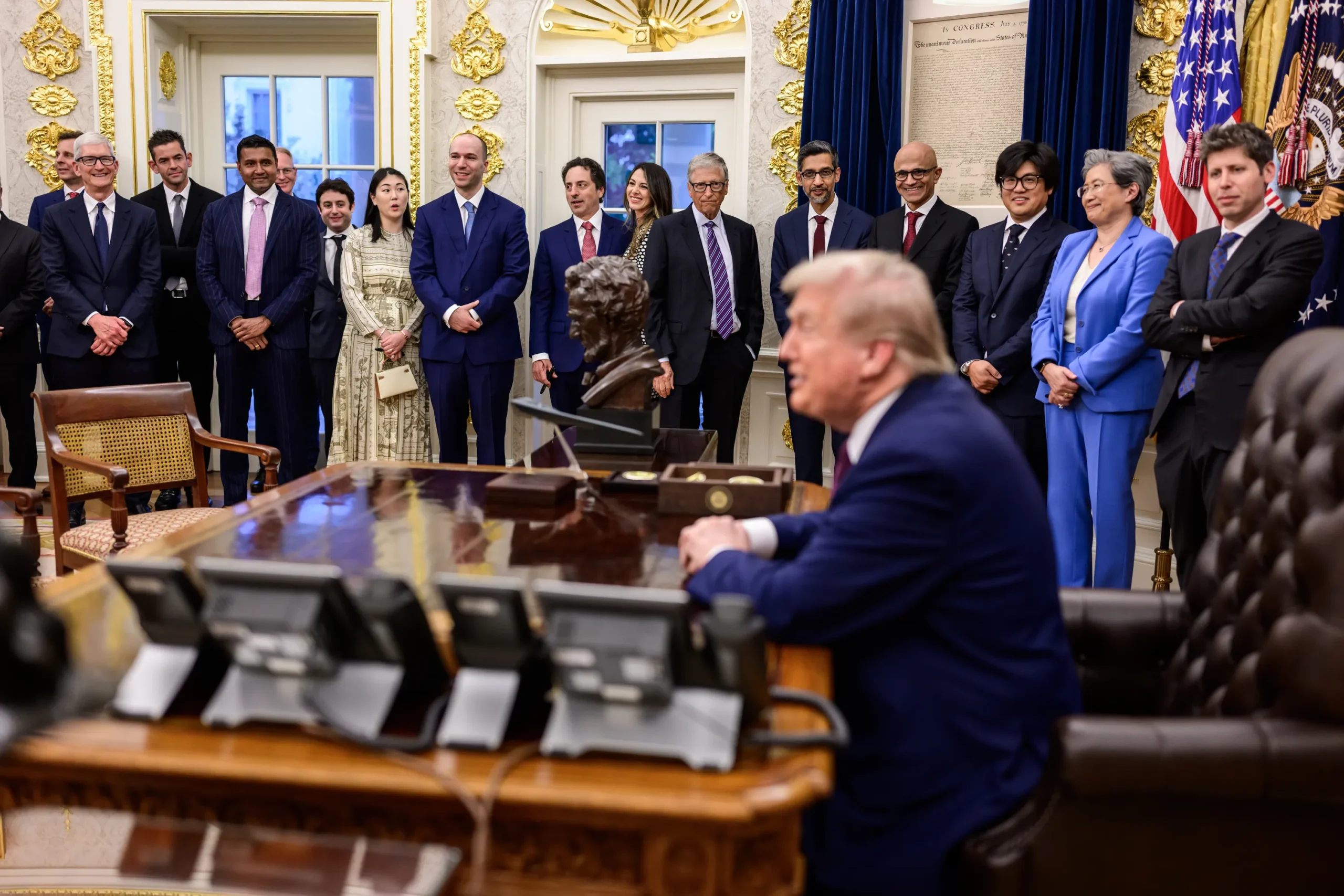
President Donald Trump has appointed top tech leaders—including Mark Zuckerberg and Jensen Huang—to the President’s Council of Advisors on Science and Technology (PCAST), signaling a major push to align government policy with the private sector as the U.S. races to dominate artificial intelligence. The newly formed council will play a key role in advising the White House on AI, innovation, and the future of the American workforce.
Big Tech Leaders Step Into Government Advisory Roles
The council is made up largely of influential executives from major tech companies and venture firms.
Key appointees include:
- Mark Zuckerberg (Meta)
- Jensen Huang (Nvidia)
- Larry Ellison (Oracle)
- Sergey Brin (Google)
- Lisa Su (AMD)
- Michael Dell (Dell)
The group represents some of the most powerful figures in AI, semiconductors, and global tech infrastructure.
Council Focused on AI, Workforce, and Innovation
The advisory group will help shape national strategy around emerging technologies.
Core responsibilities include:
- Advising on artificial intelligence policy and regulation
- Addressing workforce changes driven by automation
- Supporting U.S. competitiveness against global rivals like China
- Guiding innovation across science, energy, and technology sectors
The council is expected to play a central role in shaping how the U.S. approaches the AI revolution.
White House Aligns Closer With Private Tech Sector
This move reflects a growing partnership between government and major tech companies.
Key dynamics:
- Increased reliance on private-sector expertise for policymaking
- Stronger collaboration between Big Tech and federal leadership
- Influence of billion-dollar companies on national AI strategy
- Expansion of industry voices in government decision-making
Notably, the council is heavily composed of industry executives, signaling a shift away from traditional academic advisory roles.
Part of a Larger AI Strategy Push
The council is just one piece of a broader effort to position the U.S. as a global AI leader.
Recent initiatives include:
- A national AI policy framework aimed at boosting innovation
- Efforts to reduce regulatory barriers for tech companies
- Increased investment in AI infrastructure and research
- Strategic focus on competing with China in AI development
The administration has made AI dominance a central priority of its long-term economic strategy.
Concerns Over Influence and Oversight
While the move is seen as pro-innovation, it has also raised concerns.
Critics argue:
- Big Tech may have too much influence over government policy
- Conflicts of interest could shape regulatory decisions
- Limited academic representation may skew perspectives
- Public accountability could be reduced in decision-making
The composition of the council has sparked debate about who should guide the future of AI policy.
Why This Matters
This development signals a major shift in how technology policy is being shaped in the U.S.:
- Big Tech is playing a direct role in government decision-making
- AI policy is becoming a national strategic priority
- Public-private partnerships are accelerating innovation efforts
- The future of regulation may be influenced by industry leaders
As AI becomes the defining technology of the next decade, the collaboration between government and companies like Meta and Nvidia could shape the global balance of power in tech.
- Arizona State Senate Considering Adding Bitcoin ETF To Retirement Portfolios
- State of Wisconsin Buys Nearly $100M Worth of BlackRock Spot Bitcoin ETF
- Minnesota Becomes First Midwest State to Allow Banks to Offer Crypto Custody Services
- Grayscale HBAR ETF Advances as Nasdaq Submits 19b-4 Filing to SEC
- Jersey City to Invest in Bitcoin ETFs, the Latest Pension to Dive Into Crypto
- Bitcoin ETF Pump Fake: Hacked SEC Twitter account falsely posts agency approved Bitcoin ETFs