












































































































































































































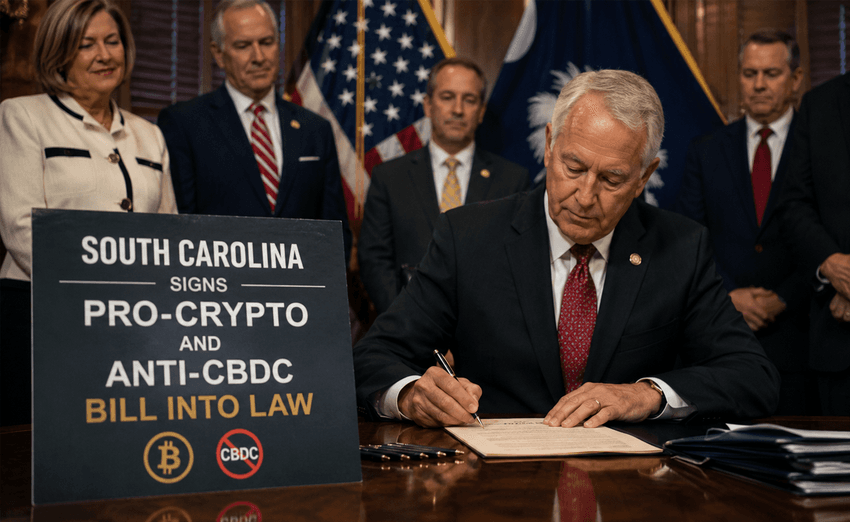
South Carolina has officially passed one of the most crypto-friendly state laws in the country after Governor Henry McMaster signed Senate Bill 163 into law. The legislation creates broad legal protections for crypto users, Bitcoin miners, blockchain developers, and self-custody rights while also banning state participation in central bank digital currency (CBDC) programs.
The bill passed with overwhelming bipartisan support, clearing the South Carolina Senate in a 38-1 vote and the House in a 110-1 vote before being signed into law on May 19.
South Carolina Officially Rejects CBDCs
One of the most significant sections of the law prohibits South Carolina government agencies from:
- Accepting CBDC payments
- Requiring CBDC usage
- Participating in Federal Reserve CBDC pilot programs.
The legislation applies broadly across:
- State agencies
- Departments
- Boards
- Political subdivisions.
Lawmakers behind the bill framed the anti-CBDC provisions as a response to concerns around:
- Financial surveillance
- Privacy
- Government overreach
- Centralized control over digital money.
The move places South Carolina among a growing number of states pushing back against potential federally issued digital currencies.
Self-Custody and Crypto Payments Receive Legal Protection
The law also establishes strong protections for crypto users themselves.
Under the new framework, individuals and businesses cannot be prohibited from:
- Accepting crypto as payment
- Using hardware wallets
- Holding assets in self-hosted wallets
- Maintaining direct self-custody of digital assets.
The legislation additionally prevents state or local governments from imposing extra taxes or fees on transactions simply because crypto was used instead of U.S. dollars. Lawmakers described the goal as ensuring digital assets are treated fairly alongside traditional forms of payment rather than being singled out for separate taxation or restrictions.
Bitcoin Miners and Blockchain Developers Gain Protections
The law includes several provisions specifically designed to protect blockchain infrastructure activity inside the state. Local governments are now restricted from imposing discriminatory zoning or noise regulations targeting Bitcoin mining businesses operating in industrial zones. Mining operations must instead follow the same standards applied to other industrial businesses. The legislation also exempts several blockchain-related activities from money transmitter licensing requirements, including:
- Mining
- Node operations
- Blockchain software development
- Crypto-to-crypto trading
- Certain staking-related services.
This significantly reduces regulatory barriers for blockchain companies and infrastructure operators working inside South Carolina.
Part of a Growing State-Level Crypto Movement
South Carolina’s law reflects a larger trend happening across the United States as states increasingly build their own crypto frameworks independent of federal regulation. States like:
- Kentucky
- Wyoming
- Montana
- Utah
have recently passed similar legislation focused on:
- Self-custody protections
- Mining rights
- Blockchain business exemptions
- Anti-CBDC measures.
As Congress continues debating national crypto legislation, many states are moving faster to attract blockchain businesses and establish clearer digital asset rules locally.
- Former Celsius CEO Alex Mashinsky to Plead Guilty to Celsius Fraud Charges
- Court Denies SEC, Ripple Settlement Motion After Finding Procedural Misstep
- Bessent Pushes for Summer Passage of CLARITY Act as U.S. Bitcoin Reserve Moves Forward
- Nvidia Hit with Crypto Lawsuit From SEC and DOJ
- Elizabeth Warren Demands U.S. CFTC Chair Explain His Chats With SBF
- SEC Removes Ripple Lawsuit From its Website as Case Moves to Appeals Court