

















































































































































































































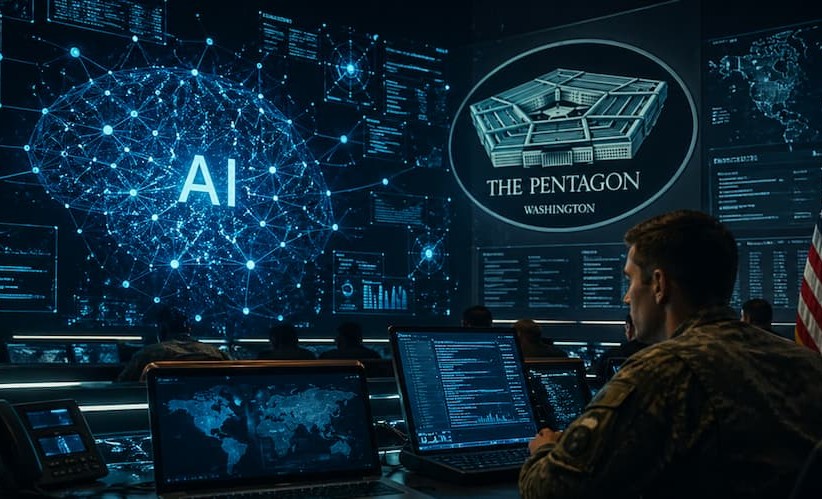
The U.S. Department of Defense has secured landmark agreements with leading AI companies—including OpenAI,
AI Deployment Across Top-Secret Military Networks
Under the agreements, these companies will provide AI models and infrastructure that can operate within the Pentagon’s highest-security classified networks. The systems are intended for “lawful operational use,” meaning they will support intelligence, planning, and operational workflows rather than fully autonomous combat systems.
This includes:
- Processing massive datasets
- Enhancing battlefield intelligence
- Supporting real-time decision-making
Goal: Build an “AI-First Fighting Force”
The Pentagon made its ambition clear—these partnerships are designed to transform the U.S. military into an “AI-first fighting force” capable of maintaining decision superiority across modern warfare domains.
Officials believe AI will:
- Accelerate military planning and simulations
- Improve logistics and targeting efficiency
- Strengthen cybersecurity and threat detection
The initiative reflects growing urgency as global competitors like China rapidly advance their own military AI capabilities.
Seven Key Companies Powering the Initiative
The full list of companies involved highlights how deeply Big Tech is now embedded in national defense:
- OpenAI
- Microsoft
- Amazon Web Services
- Nvidia
- SpaceX
- Reflection AI
Notably, AI company Anthropic was excluded after refusing to loosen safety restrictions, highlighting tension between ethics and military use.
Human Oversight Still Required
Despite the масштаб of these deals, the Pentagon emphasized that AI systems will operate under human supervision, particularly for sensitive or lethal decisions.
Companies like OpenAI and Google
- Limits on domestic surveillance use
- Restrictions on autonomous weapon deployment
However, once deployed, companies may not have full control over how the government ultimately uses the technology.
Rising Ethical Concerns Inside Big Tech
The deals have sparked internal backlash—especially at Google, where employees warned about the risks of contributing to military AI systems.
Broader concerns include:
- AI accelerating warfare decisions too quickly
- Automation bias leading to critical errors
- Blurred lines between defense and offensive use
This places tech companies at the center of a growing ethical debate around AI militarization.
The Bigger Picture
This moment marks a major shift: AI is no longer just a commercial tool—it’s now core infrastructure for national security. By partnering with Big Tech, the Pentagon is embedding AI directly into the foundation of modern warfare. The real question now isn’t whether AI will shape the future of defense—it’s how far it goes, and who controls its limits.
- HTC Unveils Eye-Tracking Vive Focus Vision Standalone VR Headset
- Bitcoin Policy Institute Joins Palantir and Anduril in New U.S. State Department Technology Program
- Trump-Linked Crypto Firm Partners With Spacecoin For Satellite DeFi
- DogWifHat Community Raises $690K To Put Meme On Vegas Sphere
- Sam Altman’s Worldcoin gets new Orb Mini and US launch
- Meta Thinks its Orion Augmented Reality Glasses Can Be The AirPods of AR