




































































































































































































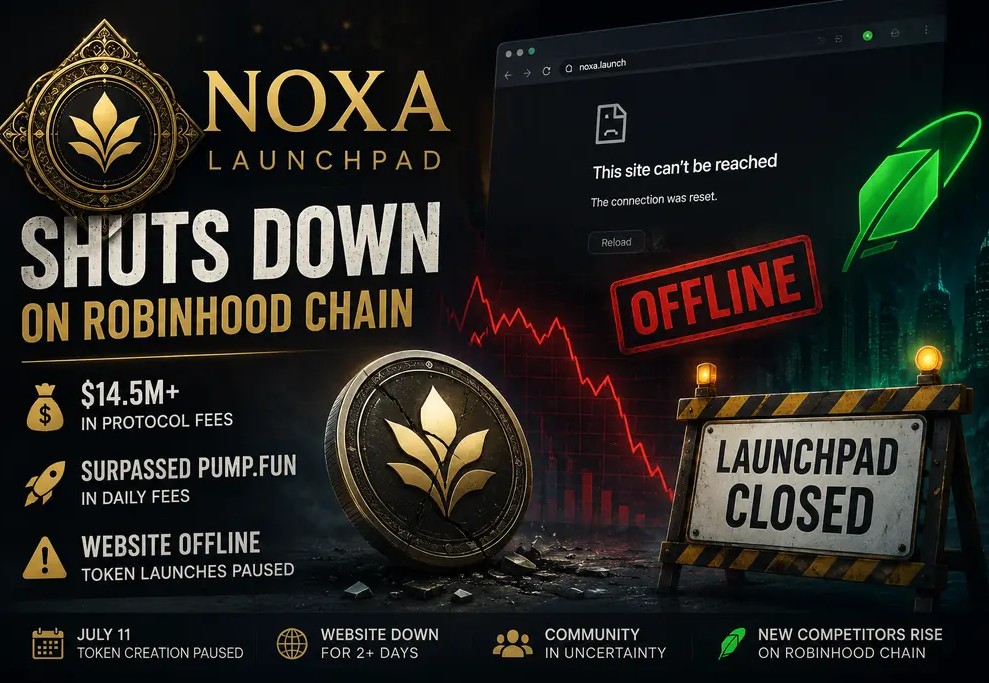
NOXA, the launchpad responsible for approximately 75% of all token deployments on Robinhood Chain, has abruptly halted new token launches and lost control of its primary web domains after generating roughly $12 million in protocol fees within just two weeks. The sudden shutdown has sparked concerns about the long-term stability of Robinhood Chain, revealing how heavily the network’s explosive early growth depended on a single third-party application. The incident triggered sharp declines across several ecosystem memecoins and reignited debate over centralization risks within supposedly decentralized ecosystems.
Although Robinhood does not operate NOXA directly, the launchpad had become the primary engine driving activity across the newly launched blockchain. With more than 60,000 tokens deployed, over 267,000 unique wallets onboarded, and billions of dollars in decentralized exchange volume generated within days of launch, NOXA’s disappearance has left a significant gap in the network’s infrastructure.
The Platform Behind Robinhood Chain’s Memecoin Boom
NOXA quickly emerged as the dominant launchpad after Robinhood Chain launched earlier this month.
According to on-chain data, the platform:
- Deployed more than 60,000 tokens.
- Accounted for roughly 75% of all token launches.
- Attracted over 267,000 unique wallets.
- Generated approximately $12 million in protocol fees.
- Outperformed Pump.fun in daily protocol fees for five consecutive days.
Its rapid growth helped Robinhood Chain surpass $4 billion in cumulative decentralized exchange volume in less than two weeks, making it one of the fastest-growing Layer-2 ecosystems of 2026.
How the Shutdown Unfolded
The collapse occurred over several days.
On July 11, NOXA stopped accepting new token launches, citing an overwhelming surge of bot activity, copycat token spam, and infrastructure strain caused by explosive network growth.
Soon afterward, the platform’s website began returning maintenance messages and 503 server errors. The team initially blamed the outage on Cloudflare-related infrastructure issues, assuring users that on-chain funds remained secure.
Days later, NOXA revealed it had also lost control of its web domains, claiming its registrar had either taken over or resold the domains. The team said its only remaining interface was accessible through an Ethereum Name Service (ENS) address.
Memecoin Market Suffers Immediate Impact
Because NOXA powered the majority of Robinhood Chain’s token launches, its disappearance quickly affected the broader ecosystem.
Following the shutdown:
- CASHCAT fell more than 33% in one day.
- The token later declined nearly 75% from its peak.
- Numerous ecosystem memecoins experienced similar selloffs.
- New token creation activity slowed significantly.
The price declines highlighted how dependent the network had become on a single application to generate user activity and liquidity.
Was It a Soft Rug Pull?
The sudden shutdown led many traders to accuse NOXA’s operators of conducting a “soft rug pull,” arguing that a platform earning millions of dollars in fees should not voluntarily cease operations.
However, blockchain data tells a more nuanced story.
According to investigators and community researchers:
- Liquidity for launched tokens remains locked.
- Creator fee distributions continue functioning.
- Smart contracts remain operational.
- No evidence has emerged showing developers drained liquidity pools or removed funds from protocol contracts.
Instead, the available evidence suggests the issues stemmed from infrastructure failures and operational problems rather than a traditional rug pull.
Robinhood Chain’s Single Point of Failure
The incident exposed a broader structural concern for Robinhood Chain.
While the blockchain itself remains fully operational, much of its early adoption, transaction volume, and user growth originated from one application.
This creates what analysts describe as a single point of failure, where the success of an entire ecosystem becomes overly reliant on one dominant protocol rather than a diverse collection of decentralized applications.
Without a stable replacement launchpad, Robinhood Chain could struggle to maintain the rapid growth that initially attracted developers and traders.
Growing Security Concerns Around Robinhood Chain
The NOXA shutdown comes amid increasing concerns surrounding Robinhood Chain’s rapidly expanding memecoin ecosystem.
In recent days, users have also encountered:
- Scam token launches.
- Copycat projects.
- Honeypot contracts.
- Wallet-draining scams.
- Fake developer impersonations.
These incidents highlight the growing challenges faced by permissionless blockchain networks as they scale rapidly and attract speculative trading activity.
What This Means for Crypto
The collapse of NOXA serves as a reminder that decentralized blockchains can still become heavily dependent on centralized infrastructure at the application layer. While Robinhood Chain itself continued operating normally, much of its impressive early adoption relied on a single launchpad whose operational problems immediately impacted activity across the ecosystem.
For the broader Web3 industry, the incident reinforces an important lesson: healthy blockchain ecosystems require a diverse network of developers, launchpads, liquidity providers, and decentralized applications—not just high transaction counts driven by one dominant platform. As tokenization and Layer-2 adoption continue accelerating, investors will increasingly evaluate not only blockchain performance but also the resilience of the surrounding application ecosystem.
If Robinhood Chain can attract multiple competing launchpads and strengthen its developer ecosystem, it may recover from NOXA’s collapse. If not, the episode could become an early case study in how rapid growth built around a single application can expose hidden centralization risks within an otherwise decentralized network.
- Morgan Stanley’s Bitcoin ETF Draws $34M on Day One, Signaling Strong Institutional Demand
- XRP Price Skyrockets Past $1 as SEC Faces Legal Troubles & Favorable Regulatory Shift Looms
- Polymarket Will Launch Token and Airdrop After U.S. Relaunch, CMO Says
- Messi, Ronaldinho Pump Little-Known Solana Meme Coin $WATER
- Digital Assets Dip: Bitcoin Plunges 7% to $42,000 in Flash Crash as Bull Run Falters
- Shein Hits Wall Street and the Blockchain on the Same Day With $SHEINx