





































































































































































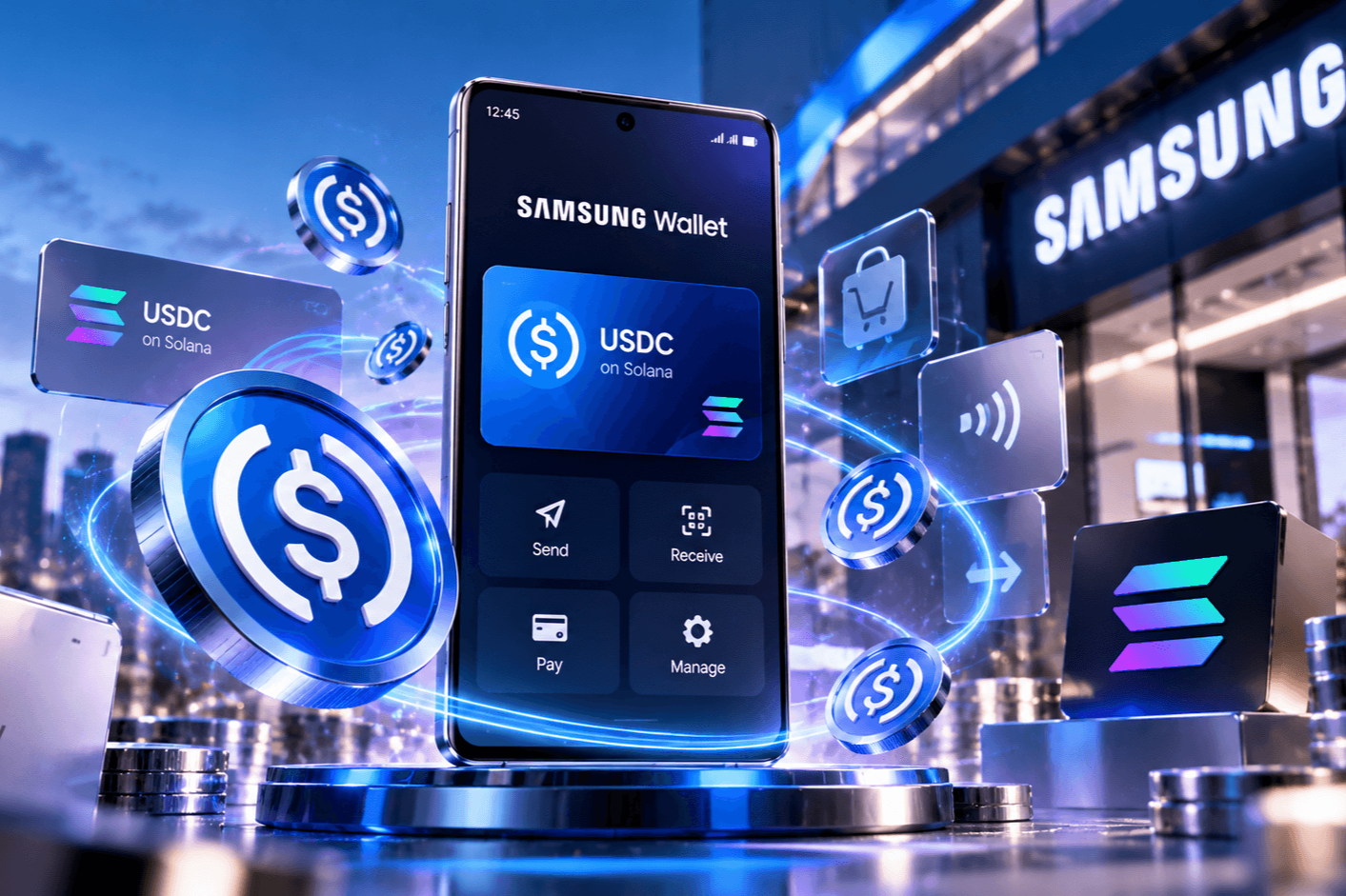
Samsung Electronics has officially launched support for USD Coin (USDC) on the Solana blockchain through its Samsung Wallet application, bringing cryptocurrency functionality to approximately 82 million compatible Galaxy devices across the United States. Announced on November 5, 2026, the new feature allows eligible users to buy, hold, send and receive the dollar-pegged stablecoin directly through Samsung Wallet without downloading a separate cryptocurrency application or managing private keys. Developed in partnership with Circle, Solana, Bastion and Coinbase, the service also enables international money transfers to eligible bank accounts in more than 60 countries, potentially making blockchain-based payments more accessible to everyday consumers. The launch represents a major step toward mainstream stablecoin adoption as one of the world’s largest smartphone manufacturers integrates digital dollars into an application already used for traditional payments, identification and digital credentials.
Samsung Officially Launches Stablecoin Accounts for U.S. Galaxy Users
On November 5, Samsung Electronics and the Solana Foundation announced that stablecoin functionality was available inside Samsung Wallet, following an initial announcement on October 7.
The Solana Foundation confirmed that the feature began going live on November 2, with the broader announcement arriving three days later.
The integration allows eligible Samsung Galaxy owners to access USDC, a cryptocurrency issued by Circle and designed to maintain a value of approximately one U.S. dollar.
Unlike conventional cryptocurrency wallets that require users to install specialized applications and manage blockchain private keys, Samsung’s implementation integrates stablecoin functionality directly into its existing digital wallet.
Users can access their stablecoin account alongside the payment cards, boarding passes and identification documents already stored within Samsung Wallet.
The new functionality supports several activities:
Buy and hold USDC directly within Samsung Wallet.
Send and receive stablecoins through the Solana blockchain.
Transfer USDC to compatible external cryptocurrency wallets without a Samsung transfer fee.
Send money to eligible bank accounts in more than 60 countries, with recipients receiving funds in their local currencies where supported.
Samsung estimates that approximately 82 million Galaxy devices in the United States are compatible with the service, providing a potentially substantial distribution network for blockchain-based payments.
However, that figure represents compatible devices rather than the number of users who have activated stablecoin accounts.
Solana Blockchain Powers Samsung’s Digital Dollar Transactions
The integration uses the Solana blockchain to process USDC transfers, allowing users to move digital dollars without directly interacting with blockchain infrastructure.
Solana is known for its high transaction throughput and relatively low transaction fees, characteristics that have made the network increasingly attractive for stablecoin payments and financial applications.
By operating through Samsung Wallet, the blockchain functions largely behind the scenes while users interact with a familiar payment interface.
This approach is designed to reduce the technical barriers that have historically prevented many consumers from using cryptocurrency for everyday financial transactions.
Lily Liu, President of the Solana Foundation, described the partnership as an important development in bringing stablecoins beyond cryptocurrency-focused audiences.
The launch also builds on Solana’s growing role in digital payments.
According to the Solana Foundation, the network has processed more than $5.25 trillion in stablecoin transaction volume during 2026, while its stablecoin supply has increased approximately 20% year over year.
Major payment companies, including PayPal and Western Union, have also pursued stablecoin initiatives involving Solana.
Samsung’s participation could further expand the network’s reach by connecting blockchain-based financial services to millions of existing smartphone users.
Bastion and Coinbase Provide Custody and Security Infrastructure
Although Samsung Wallet provides the user interface, Samsung does not directly custody the cryptocurrency held within stablecoin accounts.
Instead, the service relies on a partnership with Bastion, a regulated digital asset custody and infrastructure provider, and Coinbase, one of the largest cryptocurrency exchanges in the United States.
Bastion operates the stablecoin account and payment infrastructure, while Coinbase serves as its sub-custodian.
Customer USDC is safeguarded through Coinbase Prime Vault, an institutional digital asset custody service.
The arrangement allows Samsung to provide cryptocurrency functionality without requiring individual users to manage private keys or independently secure blockchain wallets.
Samsung Galaxy devices also use biometric authentication to authorize transactions, adding another layer of protection against unauthorized access.
However, the custodial structure means users rely on third-party financial service providers rather than maintaining exclusive control over their cryptocurrency assets.
Samsung has emphasized that its stablecoin accounts are cryptocurrency wallets, not traditional bank accounts.
The company is not acting as a bank, money transmitter or digital asset custodian, and it does not directly hold customer funds.
This distinction is important because cryptocurrency balances may not receive the same regulatory protections as conventional bank deposits.
Samsung Enables International USDC Transfers to More Than 60 Countries
One of the most significant features of the integration is the ability to send money internationally using stablecoins.
Eligible users can transfer USDC to compatible cryptocurrency wallets or send funds to qualifying bank accounts in more than 60 countries.
When transferring money to an eligible international bank account, recipients may receive the payment in their local currency rather than cryptocurrency.
This process combines blockchain-based transfers with traditional financial payment infrastructure.
For example, a Samsung Wallet user in the United States could initiate an eligible international transfer using USDC, while the recipient receives local currency through a supported banking partner.
The service is designed to simplify cross-border payments without requiring both parties to maintain cryptocurrency wallets.
Samsung does not charge a transfer fee when users send USDC to other Samsung Wallet users in the United States or to compatible external cryptocurrency wallets.
However, other service providers may impose additional charges.
International bank transfers also carry fees that vary depending on the destination country and transfer amount.
The application displays applicable charges and estimated delivery times before users confirm eligible transfers.
The integration could eventually compete with portions of the traditional international remittance market, where customers frequently encounter transaction fees, currency conversion costs and processing delays.
However, actual savings will depend on the payment method, destination and associated service charges.
Samsung Wallet Introduces Stablecoin Fees and $25 USDC Promotion
Although the service provides fee-free USDC transfers under certain conditions, other activities involve transaction charges.
According to the launch details, users funding their stablecoin accounts with a credit card, including through Samsung Pay, will incur a 4% transaction fee.
Withdrawals to linked bank accounts or debit cards may also involve additional charges.
Samsung is offering a promotional incentive to encourage new users to explore the service.
Eligible first-time users who add at least $50 to their stablecoin accounts can receive a $25 USDC bonus, subject to the promotion’s terms.
The initial offering includes several important conditions:
Eligibility: U.S. residents aged 18 or older with compatible Galaxy devices.
Device requirements: Android 13 or newer, a Samsung Account, identity verification and biometric authentication.
Geographic restrictions: New York residents are currently excluded.
Supported asset: USDC is the initial stablecoin available through the service.
Transfer fees: No Samsung fee for eligible USDC wallet transfers, while funding, withdrawals and international bank transfers may carry charges.
The restrictions reflect the regulatory and operational requirements associated with providing cryptocurrency services to consumers in the United States.
Additional states, countries and payment methods could become available as Samsung expands the service and secures the necessary regulatory support.
Samsung Builds on Previous Coinbase and Cryptocurrency Partnerships
The new stablecoin functionality represents another stage in Samsung’s broader expansion into cryptocurrency and blockchain technology.
Samsung first introduced cryptocurrency-related wallet capabilities through its Samsung Blockchain Wallet ecosystem in 2019.
The company subsequently expanded hardware wallet compatibility and other digital asset features.
In October 2025, Samsung announced a partnership with Coinbase that provided eligible Galaxy users with access to Coinbase-related services and benefits through Samsung Wallet.
That collaboration helped establish the foundation for deeper cryptocurrency integration within Samsung’s mobile ecosystem.
In July 2026, Samsung previewed plans to introduce native stablecoin functionality during its Galaxy Unpacked event in London.
The company initially demonstrated how USDC could appear alongside conventional payment options but did not immediately disclose all technical partners or launch details.
The October announcement confirmed Solana’s role in the integration, while the November launch made the service available to eligible users.
By combining its existing mobile payment infrastructure with cryptocurrency custody and blockchain settlement technology, Samsung is pursuing a model that integrates digital assets into mainstream consumer financial services.
Samsung Plans Future Stablecoin Payments at Stores and Online
Beyond transfers and stablecoin account management, Samsung is exploring additional payment capabilities.
The company has indicated that future developments could allow eligible users to make purchases using stablecoins through online checkout systems and contactless payments at physical retailers.
Such functionality could eventually allow consumers to use digital dollars for everyday purchases through the same application they already use for credit and debit cards.
However, Samsung has not announced a confirmed launch date for direct online or in-store stablecoin purchases.
The company is also considering expanding its stablecoin services into additional international markets, subject to local regulations and financial service requirements.
Samsung’s broader stablecoin strategy could eventually support multiple blockchain networks.
While the current launch focuses on USDC transfers through Solana, Samsung has also identified Sui among the blockchain infrastructure partners involved in its wider stablecoin plans.
The company has not confirmed that every supported network or payment capability will be available immediately.
The expansion of stablecoin payments into smartphone wallets could increase competition among financial technology providers, cryptocurrency companies and traditional payment networks.
Samsung’s USDC Launch Could Accelerate Mainstream Stablecoin Adoption
The launch of USDC on Samsung Wallet represents a significant development in the growing relationship between cryptocurrency infrastructure and traditional consumer technology.
For years, stablecoins have primarily been used by cryptocurrency traders, decentralized finance platforms and businesses moving funds between digital asset networks.
Samsung’s integration introduces a different distribution model by making digital dollars available through an application already familiar to millions of consumers.
Rather than requiring users to understand blockchain networks, private keys or decentralized applications, the service places stablecoin functionality inside an existing mobile payment environment.
For Circle, the integration creates another distribution channel for USDC and potentially expands its use in everyday financial transactions.
For Solana, the partnership strengthens its position as a blockchain network supporting consumer payments and institutional financial applications.
For Coinbase and Bastion, the collaboration demonstrates the growing importance of regulated custody and financial infrastructure in connecting cryptocurrency services with mainstream technology companies.
However, widespread adoption will depend on factors including transaction costs, regulatory availability, customer trust and whether stablecoin transfers provide meaningful advantages over existing payment services.
The service’s availability across approximately 82 million compatible Galaxy devices creates substantial potential reach, but it does not guarantee that all eligible users will adopt cryptocurrency payments.
Nevertheless, Samsung’s decision to integrate USDC directly into its digital wallet demonstrates how stablecoins are increasingly moving beyond cryptocurrency exchanges and into established consumer financial platforms.
As additional technology companies explore blockchain-based payment services, stablecoins could become an increasingly important component of digital commerce, international money transfers and mobile financial applications.
The Samsung Wallet launch offers an early example of how that transition could occur, bringing blockchain-powered digital dollars into a familiar consumer application without requiring users to manage the underlying technology themselves.
- Nvidia announces $3,000 personal AI supercomputer called Digits
- Worldcoin Rebrands as World, Launches New Eyeball Scanning Orb
- Ledger Alerts Users to Fake Letter Scam Making Rounds
- Ledger Teases Partnership with Pudgy Penguins
- Magic Leap, Google Unveil New Android XR Smart Glasses
- Solana Mobile Launches SKR Token Airdrop for Seeker Phone Users