














































































































































































































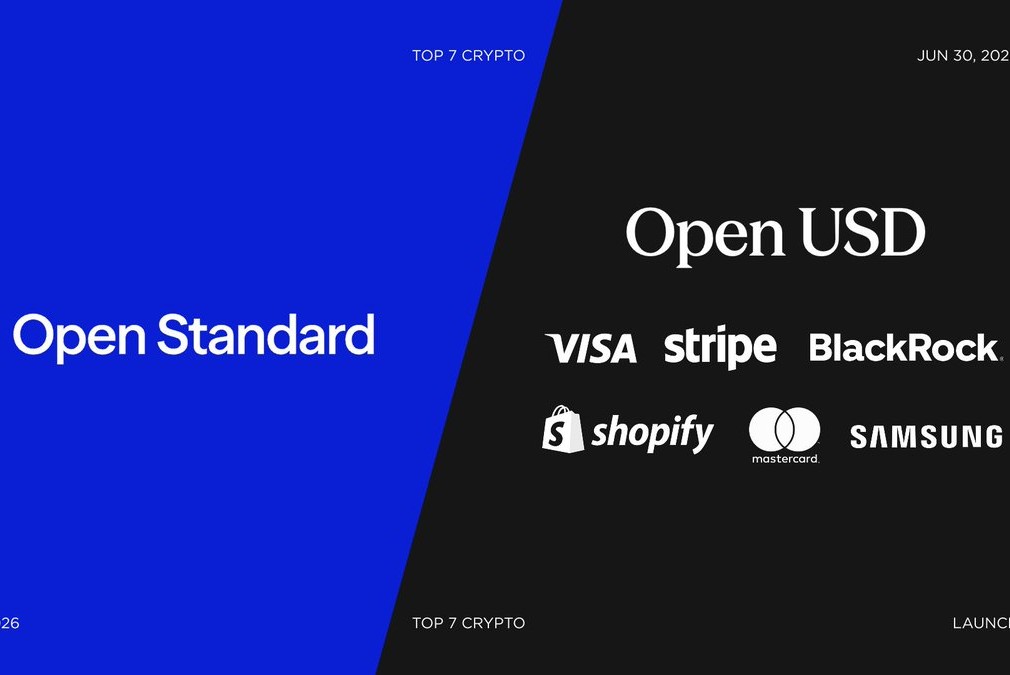
A powerful coalition of more than 140 global companies has joined forces to launch a new dollar-backed stablecoin that could dramatically reshape the digital payments industry. The initiative, known as Open USD (OUSD) and developed by Open Standard, brings together some of the biggest names in finance, payments, technology, and crypto—including Stripe, Visa,
The announcement immediately sent shockwaves through the market. Shares of Circle Internet Group fell more than 17% following the news as investors questioned whether USDC’s long-standing dominance could be threatened by a consortium backed by some of the world’s largest financial institutions and payment networks.
A Stablecoin Built for Businesses
Unlike most existing stablecoins, Open USD is being designed as a collaborative network rather than a product controlled by a single issuer.
Businesses participating in the consortium will be able to mint and redeem OUSD without paying fees or facing volume restrictions. More importantly, participating companies will receive a share of the interest generated by the reserves backing the stablecoin after operating costs are deducted. Under today’s dominant stablecoin model, reserve income is largely retained by issuers such as Circle and Tether.
The project is being led by Zach Abrams, co-founder of stablecoin infrastructure company Bridge, which was acquired by Stripe. Abrams said businesses need a stablecoin that is open, scalable, low-cost, and aligned with the interests of the companies using it rather than a single issuer.
More Than 140 Industry Leaders Join the Network
The breadth of support behind Open USD makes it one of the largest collaborative efforts ever announced in the stablecoin industry.
Launch partners span multiple sectors, including payment processors, banks, fintech firms, blockchain companies, and technology providers. Among the most recognizable participants are:
- Stripe
- Visa
- Mastercard
- Coinbase
- BlackRock
- BNY
- Standard Chartered
- DBS
- Ripple
- Solana
- Polygon
- MetaMask
- Fireblocks
- Aave
- Shopify
The consortium expects Open USD to launch later this year across several blockchain networks, including Base, Solana, Polygo
Circle Faces Its Biggest Competitive Threat Yet
Perhaps the biggest immediate impact was felt by Circle, issuer of the USDC stablecoin.
Circle’s stock experienced its sharpest single-day decline in months as investors reacted to the possibility that Open USD could disrupt one of the company’s primary revenue streams. Circle earns billions of dollars annually by investing USDC reserves in short-term U.S. Treasuries and retaining most of the interest generated by those assets.
Open USD flips that model by distributing reserve earnings back to participating businesses, creating stronger financial incentives for payment providers, exchanges, fintech platforms, and banks to adopt the new stablecoin.
Coinbase’s Participation Raises Eyebrows
One of the most surprising developments is Coinbase’s involvement.
Coinbase has long been one of USDC’s largest distribution partners, sharing reserve revenue with Circle through longstanding commercial agreements. By joining Open Standard, Coinbase is simultaneously supporting a stablecoin that directly competes with one of its own most important products.
Industry analysts believe Coinbase’s participation reflects a broader shift in the stablecoin market, where the value is increasingly moving from issuing the token itself to controlling distribution, payments, settlement, and financial infrastructure.
The Stablecoin Race Is Entering a New Phase
The launch comes at a time when stablecoins are rapidly becoming mainstream financial infrastructure.
Once used primarily by cryptocurrency traders, dollar-backed digital assets are now powering:
- Cross-border payments
- Merchant settlements
- Treasury management
- Global remittances
- Institutional trading
- On-chain finance
Industry forecasts suggest the stablecoin market could grow into the trillions of dollars over the coming decade, making competition among issuers increasingly focused on economics, distribution, and network effects rather than simply issuing digital dollars.
A New Revenue Model Could Reshape the Industry
The Open USD model differs significantly from existing stablecoin issuers.
Rather than centralizing reserve profits, Open Standard is designed to allow participating businesses to share in the economic benefits generated by the stablecoin. Governance will also be distributed across consortium members instead of being controlled by a single company.
Supporters argue this creates stronger incentives for widespread adoption because payment companies, exchanges, and banks directly benefit as transaction volume grows. Critics, however, note that managing governance across more than 140 organizations may prove considerably more complex than operating under a traditional centralized issuer.
- Dymension Goes Live, Airdrops $390 Million in DYM to Solana & Ethereum Users and More
- Grayscale Scraps Cardano, Polkadot and Hedera ETF Plans as Altcoins Struggle
- Morgan Stanley’s E-Trade Plans to Offer Crypto Trading as Trump Administration Signals Pro-Crypto Stance
- PEPE Leads Memecoin Gains Amid Post-Holiday Crypto Market Altcoin Rally
- Bitcoin Climbs to Multi-Week High as Bernstein Reaffirms $150,000 Price Target
- Bitcoin Drops Below $105,000, Sending Crypto Market Cap to Lowest Level Since July