








































































































































































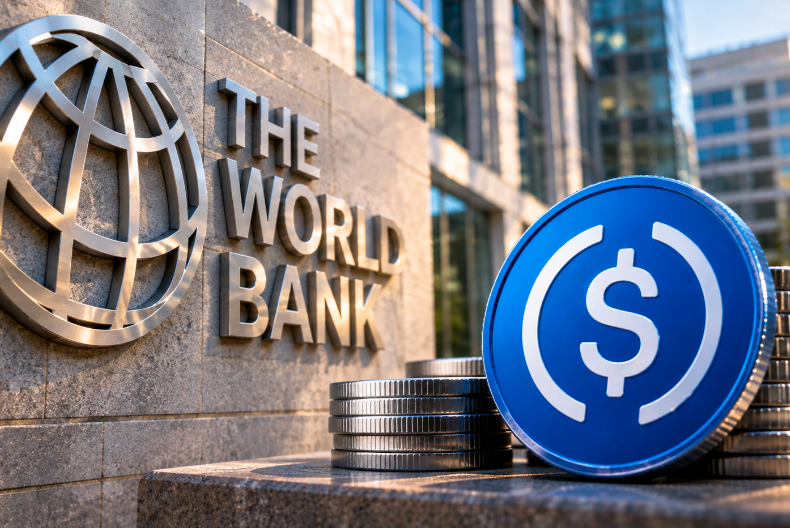
The World Bank Group has announced a partnership with Circle and Citi to explore using the USDC stablecoin for international development payments. Announced on November 17, 2026, the initiative will examine whether blockchain-based payments can reduce transaction costs, accelerate settlement times and improve transparency when distributing financial assistance to developing countries. The collaboration represents a significant step toward institutional stablecoin adoption as global financial organizations increasingly explore alternatives to traditional cross-border banking systems.
World Bank Explores USDC for International Development Payments
Under the agreement, Circle, the issuer of USDC, will provide blockchain infrastructure for minting and settling stablecoin payments, while Citi will connect the system to established banking networks.
The World Bank currently relies on correspondent banking arrangements, where international payments may pass through multiple financial institutions before reaching their destinations.
The proposed system aims to improve that process through:
Faster settlements: Potentially moving funds around the clock instead of waiting for traditional banking hours.
Lower transaction costs: Reducing delays and expenses associated with intermediary banks.
Greater transparency: Using blockchain records to improve visibility into fund transfers.
Improved accessibility: Helping development funds reach approved recipients more efficiently.
The initial phase will focus on countries where digital assets are legally permitted. The project remains exploratory, and a full commercial rollout has not been announced.
Building on 350 Projects Across 96 Countries
The initiative will build on the World Bank’s existing blockchain platform, FundsChain, which tracks how development funds are distributed and used.
According to the organization, FundsChain currently supports more than 350 development projects across 96 countries, providing participating institutions with greater visibility into financial disbursements.
World Bank Group President Ajay Banga emphasized that reducing payment delays could have a direct impact on communities, helping essential projects such as healthcare facilities and agricultural programs receive funding on time.
The World Bank Group delivered approximately $123.5 billion in financing during fiscal year 2026, demonstrating the potential significance of even modest improvements in payment efficiency.
Circle and Citi Expand Institutional Stablecoin Adoption
For Circle CEO Jeremy Allaire, the partnership demonstrates how stablecoins could serve purposes beyond cryptocurrency trading and institutional finance.
Circle has increasingly positioned USDC as infrastructure for international payments, treasury management and financial settlement.
Meanwhile, Citi, whose banking network connects clients across more than 180 jurisdictions, is developing blockchain-based payment services that combine traditional financial safeguards with digital asset technology.
Shahmir Khaliq, Citi’s Head of Services, highlighted the potential for 24/7 payment capabilities to help critical funds move more efficiently.
The World Bank also plans to explore participation from additional banking institutions as the initiative develops.
Stablecoins Could Transform Global Development Finance
The collaboration arrives as major financial institutions accelerate investment in stablecoins, tokenized deposits and blockchain settlement networks.
However, implementation will require addressing regulatory compliance, currency conversion, interoperability and the ability of recipient countries to access and use digital dollars.
The World Bank has not disclosed the pilot’s transaction volume, participating countries or implementation timeline.
For the broader Web3 industry, the World Bank’s collaboration with Circle and Citi demonstrates how stablecoins are moving beyond speculative markets toward real-world financial infrastructure. If successful, the initiative could establish a new model for distributing international development funding with greater speed, efficiency and accountability.
- Ghana Executes Cross Border CBDC Project with Singapore
- Iran Moves to Accept Crypto Payments in Weapon Sales to Evade Sanctions
- South Korea Launches Real-Time Crypto Surveillance System
- Abu Dhabi Confirms the Prohibition of Crypto Mining on Farms
- WazirX Announces Recovery Plan Post $230M Hack
- Brazil’s SEC Approves World’s First Spot XRP ETF by Hashdex