












































































































































































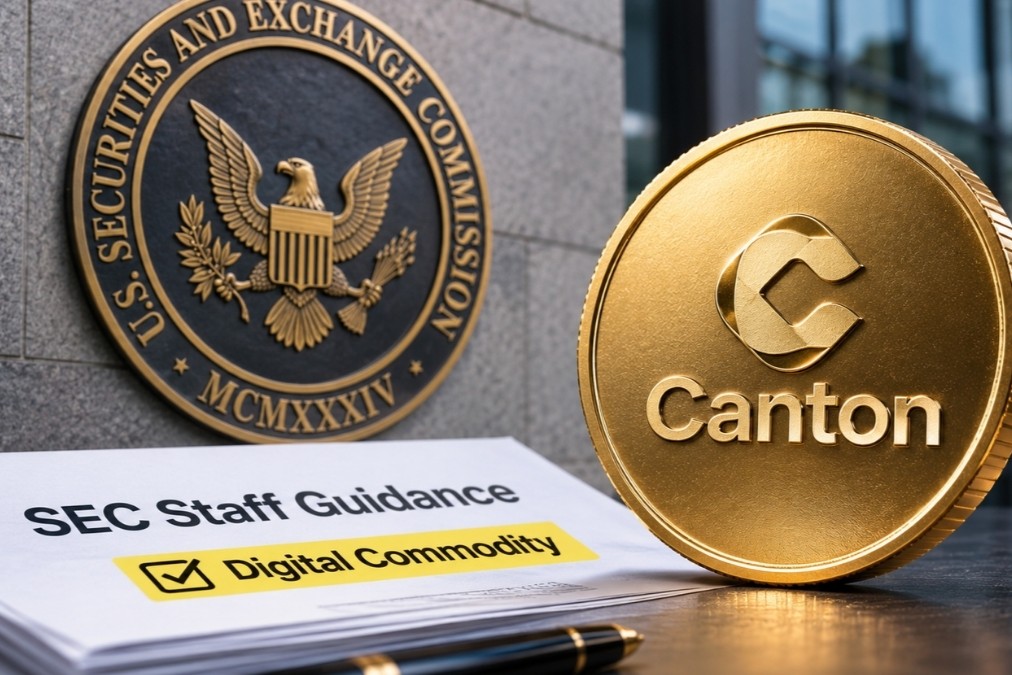
The U.S. Securities and Exchange Commission (SEC) has issued a significant regulatory decision recognizing Canton Coin (CC) as a digital commodity and agreeing not to recommend enforcement action against its programmatic token issuance under specified conditions. In a November 3, 2026 no-action letter, the SEC’s Division of Corporation Finance determined that Canton Coin derives its value from the operation of the Canton Network rather than investors relying on the managerial efforts of a centralized organization. The decision provides additional regulatory clarity for Digital Asset, the company behind Canton, and could establish an important pathway for other decentralized blockchain networks seeking to operate outside traditional securities registration requirements.
SEC Grants Canton Coin No-Action Relief
On November 3, the SEC’s Division of Corporation Finance published a no-action response addressing the regulatory treatment of Canton Coin, the native cryptocurrency powering the Canton Network.
The decision followed an October 30 request submitted by attorneys representing Digital Asset Holdings, the developer of the Canton blockchain protocol.
In its response, the SEC staff stated that it considers Canton Coin a digital commodity under the agency’s March 2026 interpretation of federal securities laws.
The division also confirmed that it would not recommend enforcement action if Canton Coin continues to be issued programmatically by network participants under the conditions described in the company’s legal submission.
The decision covers token issuance by three categories of network participants:
Super Validators: Participants responsible for critical network coordination and infrastructure.
Validators: Operators that support transaction processing and network functionality.
Application Providers: Developers and businesses contributing applications and services to the Canton ecosystem.
Under the specified conditions, these participants can receive newly minted Canton Coin without registering the issuance under Section 5 of the Securities Act of 1933 or Section 12(g) of the Securities Exchange Act of 1934.
The relief represents an important development for blockchain projects seeking regulatory certainty around tokens distributed as compensation for maintaining decentralized infrastructure.
Canton Network’s Decentralized Structure Influences SEC Decision
The SEC’s determination focused heavily on the structure and economic characteristics of the Canton Network.
According to the agency, Canton Coin’s value is tied to the programmatic operation of the blockchain and ordinary market supply-and-demand dynamics.
The SEC staff also emphasized that the network does not have a central party whose essential managerial efforts determine the token’s value.
These characteristics distinguish Canton Coin from digital assets that may be sold primarily as investment contracts promising returns from the efforts of a company or development team.
The Canton Network was developed to support secure, privacy-enabled and interoperable blockchain transactions, particularly for financial institutions operating within regulated environments.
Unlike blockchain networks that rely on public visibility of all transaction details, Canton is designed to provide transaction-level privacy while allowing institutions to interact through shared blockchain infrastructure.
Its architecture supports applications involving tokenized financial assets, collateral management, settlement and institutional payment systems.
The SEC’s position suggests that a functioning decentralized network with a clearly defined utility token may receive different regulatory treatment from projects whose tokens are primarily associated with speculative investment arrangements.
Canton Coin’s Token Distribution Model Avoids Traditional ICO Structure
Another important factor in the SEC’s assessment was how Canton Coin enters circulation.
According to Digital Asset, the Canton Network was already operational before its native token launched, allowing the project to establish real-world functionality before introducing its cryptocurrency.
Rather than conducting an initial coin offering (ICO) or selling pre-mined tokens to early investors, Canton designed its token distribution around contributions to network operations.
Participants earn Canton Coin through activities that support the blockchain’s infrastructure and ecosystem.
The token also serves a functional role within the network, including paying fees associated with the Global Synchronizer, a coordination component that enables interoperability across applications.
Those fees are burned, connecting token supply dynamics to actual network activity.
This model differs from cryptocurrency projects that raise capital through token sales before developing a functional product.
By tying token issuance to operational participation, Canton provides an example of how blockchain networks can structure digital assets around utility rather than conventional fundraising.
Digital Asset’s $355 Million Funding Round Strengthens Canton Expansion
The SEC’s decision arrives during a period of substantial institutional investment in the Canton ecosystem.
In June 2026, Digital Asset raised $355 million in a funding round led by Andreessen Horowitz’s a16z crypto fund.
The financing was intended to accelerate development of the Canton Network and expand institutional adoption of its blockchain infrastructure.
Canton has positioned itself as a blockchain platform specifically designed for financial institutions seeking to tokenize traditional assets while maintaining privacy, regulatory compliance and interoperability.
The network’s infrastructure is particularly relevant to banks, asset managers and other financial organizations exploring blockchain-based settlement systems.
The ecosystem also reached another milestone in May when 21Shares became the first U.S. exchange-traded fund issuer to offer direct exposure to Canton Coin.
Together, the investment activity, growing institutional interest and SEC regulatory relief could strengthen Canton’s position within the expanding market for tokenized financial infrastructure.
However, the SEC’s no-action letter does not constitute an endorsement of Canton Coin as an investment or guarantee the token’s future performance.
a16z Says SEC Decision Creates Pathway for Other Crypto Tokens
The SEC’s announcement received a positive response from cryptocurrency industry leaders, including Miles Jennings, a partner at a16z crypto.
Jennings described the decision as an important development for blockchain networks seeking to establish that their native tokens function as digital commodities rather than securities.
He argued that the SEC’s March 2026 token classification framework, combined with subsequent regulatory guidance, is beginning to create a clearer pathway for decentralized network tokens.
The agency’s approach could encourage blockchain developers to place greater emphasis on functioning networks, decentralized governance and token distribution tied to real operational activity.
For projects building decentralized infrastructure, the decision offers a potential regulatory model that distinguishes utility-driven blockchain tokens from traditional investment arrangements.
However, each project’s legal classification will depend on its specific structure, operations and economic characteristics.
SEC No-Action Letter Does Not Establish Universal Crypto Exemption
Despite the significance of the decision, the SEC emphasized that its response is limited to the circumstances described in Digital Asset’s submission.
A no-action letter communicates that SEC staff will not recommend enforcement action based on specific representations and conditions.
It does not constitute a formal Commission ruling, binding judicial precedent or universal exemption from securities laws.
The SEC also made clear that different facts or operating conditions could result in a different regulatory assessment.
This distinction is important because other cryptocurrency projects cannot automatically claim the same treatment simply by describing their tokens as digital commodities.
Instead, blockchain developers would need to demonstrate that their networks possess comparable characteristics, including genuine operational utility and the absence of a central party whose essential managerial efforts drive token value.
The decision also does not eliminate other potential regulatory obligations involving financial transactions, anti-money laundering compliance or applicable commodity market rules.
Canton Coin Decision Could Accelerate Institutional Blockchain Adoption
The SEC’s recognition of Canton Coin as a digital commodity represents another step toward clearer cryptocurrency regulation in the United States.
For institutional blockchain developers, uncertainty surrounding token classification has historically created challenges involving fundraising, network participation, exchange listings and infrastructure development.
By providing no-action relief for Canton’s programmatic token issuance, the SEC has demonstrated how its evolving regulatory framework can apply to decentralized networks with established functionality.
The decision could be particularly influential for projects focused on real-world asset tokenization (RWA), institutional settlement and blockchain interoperability.
As traditional financial institutions increasingly explore tokenized securities, deposits and other financial instruments, regulatory clarity surrounding the blockchain infrastructure supporting those transactions could become essential.
For Canton, the decision strengthens its ability to attract developers, validators and institutional participants without the same uncertainty surrounding the specified token issuance activities.
More broadly, the ruling highlights an emerging distinction between cryptocurrency tokens functioning as decentralized network commodities and digital assets offered through arrangements that may qualify as securities.
Although the no-action letter applies specifically to Canton Coin, its reasoning could influence how other blockchain networks structure token issuance and approach regulatory compliance.
As U.S. regulators continue refining their approach to digital assets, the Canton decision may become an important reference point in determining how decentralized blockchain infrastructure fits within the country’s evolving financial regulatory system.
- Kalshi Sues Nevada and New Jersey Over Sports Contract Ban
- Nasdaq Makes Push to Launch Trading of Tokenized Stocks
- FDIC Moves Toward Rule Confirming Tokenized Deposits Are Insured
- U.S. Treasury Expands Cyber Threat Sharing to Crypto Firms, Treating Sector as Critical Infrastructure
- Ethereum Developer Joe Schiarizzi Launches Congressional Run in Virginia With Anti-Trump, Pro-Crypto Reform Platfor
- Bored Ape NFTs Not Securities, Federal Judge Rules in Key Yuga Labs Case