














































































































































































































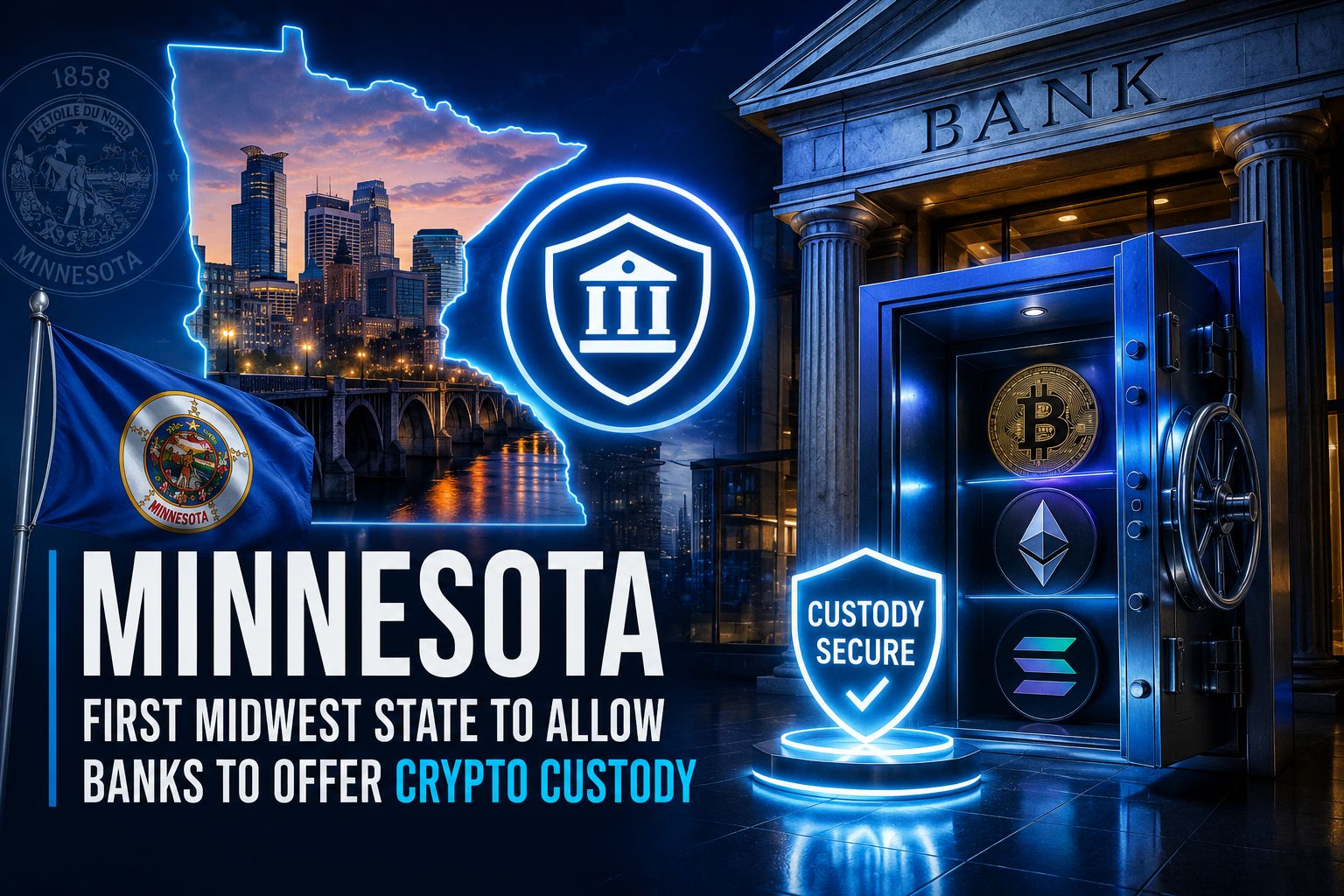
Minnesota has officially signed a new law allowing state-chartered banks and credit unions to offer cryptocurrency custody services, marking a major step forward for digital asset adoption inside traditional banking. The legislation makes Minnesota the first state in the Midwest to establish a unified legal framework for regulated crypto custody. Governor Tim Walz signed HF 3709 into law, with the new rules set to take effect on August 1, 2026.
Banks Will Be Allowed to Hold Bitcoin and Crypto for Customers
The law permits Minnesota-based banks and credit unions to custody:
- Bitcoin
- Other cryptocurrencies
- Private keys
- Certain virtual currency assets on behalf of customers.
Importantly, the legislation requires institutions to:
- Keep customer crypto separate from company assets
- Maintain written cybersecurity and risk-management policies
- Notify the Minnesota Commissioner of Commerce at least 60 days before launching custody services.
The goal is to create a regulated alternative to offshore or unregulated crypto custodians while allowing local financial institutions to evolve alongside growing customer demand for digital assets.
Traditional Banks Are Moving Deeper Into Crypto
Minnesota’s move reflects a much larger national trend as banks increasingly re-enter crypto following years of regulatory uncertainty. Over the past year:
- The OCC reaffirmed that national banks can custody crypto assets
- Major institutions like U.S. Bank, Citi, and Stripe-owned Bridge have expanded digital asset plans
- States including Wyoming, New York, and Virginia have also introduced crypto custody frameworks.
Minnesota now joins that growing list while becoming one of the first states to build a broad framework covering both banks and credit unions simultaneously.
The Law Comes Alongside a Crackdown on Crypto ATMs
Interestingly, Minnesota’s crypto expansion is happening alongside tighter restrictions in other areas. Separate legislation signed earlier this month reportedly bans crypto ATMs statewide following concerns about scams and fraud targeting residents. That creates a dual approach:
- Expanding regulated institutional crypto services
- Restricting higher-risk retail crypto access points.
The state appears to be signaling that it supports digital assets—but prefers regulated banking infrastructure over lightly supervised kiosks and cash-based systems.
The Bigger Picture
Minnesota’s new custody law highlights how quickly crypto is becoming integrated into the traditional banking system. Just a few years ago, most banks avoided digital assets entirely due to regulatory uncertainty. Now state governments and federal regulators are increasingly creating formal frameworks for:
- Crypto custody
- Stablecoin infrastructure
- Tokenized assets
- Blockchain-based financial services.
The broader shift is becoming clear:
crypto is steadily moving from the edge of finance into regulated banking infrastructure itself.
- Biden Campaign in Talks to Accept Crypto Donations Through Coinbase Commerce
- Panama City to Accept Bitcoin, ETH, Stablecoins for Taxes, Fees & Permits
- Stablecoin Legislation Is Moving in the Senate Again as Lawmakers Negotiate New Draft
- SEC Holds Meetings with BlackRock, Crypto Council to Discuss Crypto ETF Rules
- Polymarket Files for POLY Token Trademarks as Legal Battles Mount
- New Legislation Aims to Simplify Tax Rules for Staking Rewards