




































































































































































































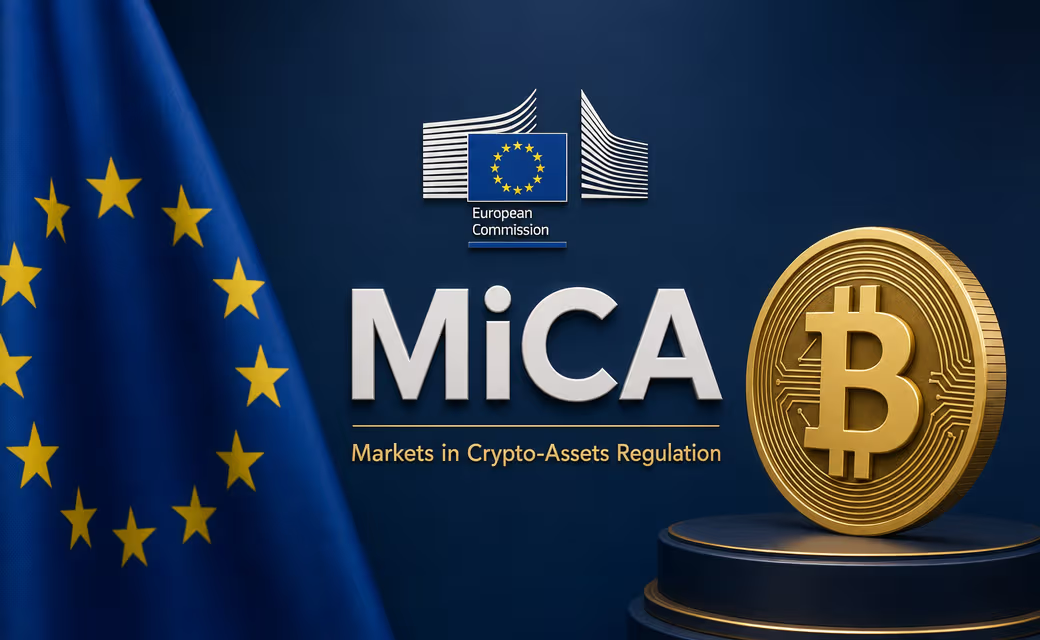
The European Union’s Markets in Crypto-Assets (MiCA) regulation has officially entered its final enforcement phase, marking one of the most significant regulatory milestones in cryptocurrency history. With the July 1, 2026 transition deadline now complete, crypto companies operating across Europe must either hold a MiCA license or significantly restrict their services within the region. The long-awaited framework replaces years of fragmented national regulations with a single licensing system that spans the entire European Economic Area (EEA), fundamentally reshaping how exchanges, custodians, brokers, and crypto service providers operate across Europe.
While MiCA is widely viewed as a major step toward regulatory clarity, the new regime is already creating clear winners and losers. Companies that secured authorization can now expand across multiple European markets under a single license, while firms that failed to obtain approval face shrinking market access, possible consolidation, or complete withdrawal from the region. The regulation represents one of the world’s most comprehensive attempts to integrate cryptocurrency into a unified financial regulatory framework.
MiCA Replaces Europe’s Patchwork of Crypto Rules
Before MiCA, cryptocurrency regulation differed significantly from one European country to another.
Many firms operated under national registration systems that allowed them to serve customers in individual jurisdictions with varying regulatory standards. Under MiCA, those fragmented systems have largely been replaced by a unified licensing framework governing crypto exchanges, custodians, brokers, wallet providers, and other Crypto-Asset Service Providers (CASPs).
Once approved by a national regulator, licensed firms can “passport” their services across all 30 countries within the European Economic Area without seeking separate licenses in each jurisdiction. Regulators believe the standardized framework will improve investor protection while making cross-border crypto services significantly more efficient.
Licensed Exchanges Become the Biggest Winners
The clearest beneficiaries of MiCA are the companies that secured authorization before the July deadline.
Major exchanges including:
- Kraken
- Coinbase
- OKX
- Crypto.com
can now continue operating across Europe under the new framework. Their licenses provide regulatory certainty while allowing expansion throughout the European market using a single authorization.
According to industry data, exchanges that already obtained MiCA licenses account for roughly 83% of European crypto trading volume, meaning most users are expected to experience minimal disruption despite the regulatory transition.
Binance Faces One of the Biggest Setbacks
One of the most notable developments involves Binance, the world’s largest cryptocurrency exchange.
Despite its global market leadership, Binance entered July without a MiCA authorization after withdrawing its Greek licensing application shortly before the deadline. The company must now evaluate alternative regulatory strategies if it hopes to continue serving European customers under the new rules.
Industry analysts believe Binance’s absence could create opportunities for licensed competitors to capture additional market share, particularly among institutional investors seeking fully regulated trading venues.
Smaller Firms Face Consolidation Pressure
While larger exchanges have largely adapted to MiCA, many smaller crypto companies face a much more difficult future.
According to the European Securities and Markets Authority (ESMA), only 244 authorized Crypto-Asset Service Providers were listed shortly before the deadline despite thousands of firms previously operating under various national registration systems.
Industry executives expect the new rules to accelerate:
- Mergers and acquisitions
- Market consolidation
- Business closures
- Strategic partnerships
- Cross-border acquisitions
Many smaller companies may seek acquisition opportunities rather than attempting to independently satisfy MiCA’s increasingly demanding compliance requirements.
Eastern Europe Faces Additional Challenges
The rollout has also exposed regulatory disparities across Europe.
Countries including Germany, France, and the Netherlands account for a significant share of approved MiCA licenses, while several Eastern European countries have far fewer authorized firms. Industry leaders argue that companies operating in markets with slower regulatory implementation may face competitive disadvantages despite offering legitimate products and services.
In Poland, for example, political delays have complicated the country’s MiCA licensing process, forcing some firms to pursue authorizations in other European jurisdictions.
Regulation Continues to Evolve
Although MiCA has now entered full force, regulators acknowledge that the framework is not finished.
Several important issues remain under discussion, including:
- Stablecoin supervision
- Cross-border token issuance
- Tokenized securities
- Real-world asset tokenization
- Decentralized finance (DeFi)
- AI-powered financial services
European policymakers have already begun reviewing potential updates to ensure MiCA remains effective as blockchain technology evolves beyond traditional cryptocurrency trading.
What This Means for Crypto
The full implementation of MiCA represents one of the most important regulatory developments in the history of digital assets. Rather than regulating crypto through fragmented national laws, Europe has created a unified framework that provides clearer rules for companies while strengthening consumer protections across one of the world’s largest financial markets.
For the broader crypto industry, MiCA is likely to accelerate institutional adoption by providing the regulatory certainty that many banks, asset managers, and publicly traded companies have been waiting for. While the framework raises compliance costs and creates new barriers for smaller firms, it also establishes a more stable foundation for long-term growth.
As other major jurisdictions—including the United States, United Kingdom, and parts of Asia—continue developing their own digital asset regulations, Europe’s experience under MiCA may serve as a blueprint for future crypto legislation worldwide. The winners in this new era are likely to be companies that embrace compliance, build institutional-grade infrastructure, and view regulation as a competitive advantage rather than an obstacle to innovation.
- European Central Bank Aims to Launch Digital Euro by 2029
- India and Nigeria Lead the World in Crypto Adoption Again, but Indonesia Is Fastest Growing, Chainalysis Report
- Zimbabwe Launches Study to Map and Regulate Crypto Industry
- Russia to Launch Crypto Exchange for Top Investors
- Indonesia’s Postal Service Debuts Inaugural NFT Stamp
- Germany Launches First Fully Digital Bond on Blockchain, Cutting Issuance Time to Just One Hour