
































































































































































































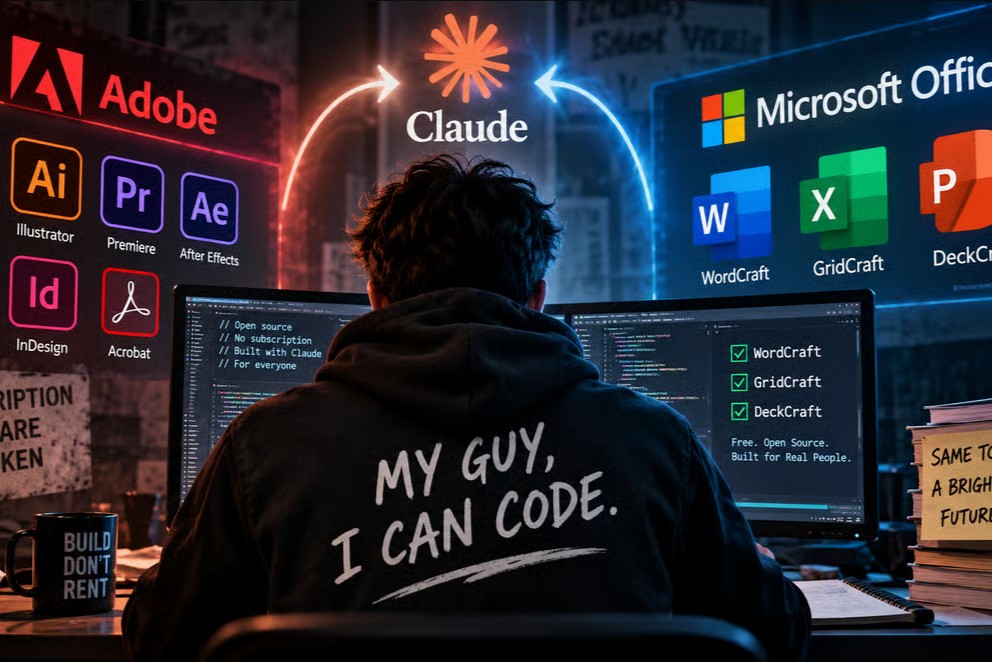
Software developer Brandon Thomas has used Anthropic’s Claude AI to create free, open-source alternatives to Microsoft Word, Excel and PowerPoint, just weeks after developing similar replacements for Adobe’s Photoshop, Illustrator, Premiere and Lightroom. The new applications, called WordCraft, GridCraft and DeckCraft, demonstrate how AI-assisted programming is dramatically reducing the time and cost required to develop complex software. Although the programs are still experimental, they could eventually challenge expensive subscription-based software from Microsoft and Adobe.
Claude AI Helps Developer Rebuild Microsoft Office
Brandon Thomas, the developer behind the ArtCraft project, has expanded his AI-assisted software development efforts into Microsoft’s productivity ecosystem.
Using Anthropic’s Claude Opus 5.5, Thomas developed three open-source applications designed to resemble Microsoft’s most widely used office programs.
The applications include:
WordCraft: An alternative to Microsoft Word for creating and editing documents.
GridCraft: A spreadsheet application modeled after Microsoft Excel.
DeckCraft: A presentation tool designed to replace Microsoft PowerPoint.
All three programs are written in Rust, a programming language known for performance and memory safety.
The software is designed to run on Windows, macOS, Linux and BSD, as well as through a web browser.
Unlike cloud-dependent productivity platforms, the applications can also operate offline.
WordCraft and GridCraft Already Reproduce Hundreds of Features
Although the projects are still in development, Thomas has already recreated a substantial portion of Microsoft’s software functionality.
According to the project’s published development figures:
WordCraft: Supports approximately 88% of Microsoft Word’s ribbon features.
GridCraft: Implements 513 of Excel’s 523 worksheet functions and 89% of its ribbon commands.
DeckCraft: Covers approximately 79% of PowerPoint’s overall features and 93% of its core features.
WordCraft can read and write DOCX files and includes features such as tracked changes, footnotes, citations and mail merge.
GridCraft supports hundreds of familiar spreadsheet formulas, although compatibility with complex real-world Excel files remains a work in progress.
DeckCraft can open and save PPTX presentations, support animations and transitions, and export presentations to PDF.
However, the developer estimates that WordCraft is only 60% ready for professional use, while GridCraft is approximately 50% ready.
DeckCraft has not yet reached its first alpha release.
AI Agents Can Control the Software Through MCP
One of the most interesting features is that the applications are designed to work directly with AI agents.
Thomas incorporated support for Model Context Protocol (MCP), a standard introduced by Anthropic that allows AI systems to interact with external applications and tools.
Instead of manually navigating menus, users could eventually instruct an AI assistant to perform tasks such as:
Create and format documents in WordCraft.
Generate spreadsheets and charts in GridCraft.
Build and edit presentations in DeckCraft.
Automate repetitive office tasks through natural-language instructions.
The applications expose their interface commands to AI agents, allowing software automation to extend beyond traditional macros and scripts.
This approach could make office productivity software more accessible to users who lack advanced technical skills.
Developer Previously Cloned Adobe Creative Cloud
The Microsoft Office alternatives follow Thomas’ earlier project, ArtCraft, which uses AI-assisted programming to recreate several Adobe Creative Cloud applications.
The project includes alternatives to:
Adobe Photoshop
Adobe Illustrator
Adobe Premiere
Adobe Lightroom
Thomas reportedly began developing the Adobe alternatives after becoming frustrated with Adobe’s subscription cancellation fees.
Using Claude, he was able to accelerate software development that would traditionally require much larger engineering teams.
The projects are described as clean-room implementations, meaning they are developed without copying the original companies’ proprietary source code.
Instead, they rely on publicly available file-format specifications and observations of how the original applications function.
That distinction matters because creating competing software is generally different from unlawfully copying protected source code, although legal questions can still depend on the implementation.
Free Software Could Challenge Microsoft’s Subscription Model
Microsoft currently charges approximately $99.99 annually for Microsoft 365 Personal and $129.99 for its Family subscription.
Adobe Creative Cloud subscriptions can cost substantially more depending on the applications and plans selected.
Thomas’ alternatives are being released under MIT and Apache 2.0 open-source licenses, allowing developers to inspect, modify and redistribute the software under the applicable license terms.
Free productivity alternatives such as LibreOffice have existed for years.
However, what makes Thomas’ projects notable is the speed at which AI-assisted development has allowed one developer to reproduce large portions of complex commercial applications.
The new software is not yet a complete replacement for Microsoft Office or Adobe Creative Cloud, but it demonstrates how AI could lower the barriers to creating competitive applications.
AI Coding Still Faces Major Limitations
Despite the rapid progress, Thomas’ applications remain experimental.
The developer has acknowledged that additional work is required before they can reliably replace commercial software.
Major limitations include:
Incomplete compatibility with complex Microsoft Office files.
Potential bugs and stability issues in early releases.
Missing advanced formatting and layout features.
Limited real-world testing compared with established commercial software.
WordCraft had reportedly attracted more than 12,000 GitHub stars by October 14, indicating significant developer interest.
However, popularity on GitHub does not establish that the software is ready for professional or business-critical use.
AI Could Transform the Economics of Software Development
Thomas’ work highlights a broader shift in the technology industry as increasingly capable AI models help developers build applications faster.
Software that once required large teams and years of development can now be prototyped much more quickly with AI-assisted coding tools.
This could increase competition across productivity software, creative applications and business automation.
It could also allow smaller developers to build specialized alternatives to expensive commercial platforms.
- Pope Leo XIV Warns AI Could Become a New “Tower of Babel” in First Major Encyclical
- Zuckerberg Training AI “CEO” Signals a Future Where Executives Could Be Replaced
- Readyverse Virtual Reality: ‘Ready Player One’ to Be Turned Into Massive Metaverse Experience in Partnership With Warner Bros Pictures Discovery
- Grayscale Launches Decentralized AI Fund Including TAO, NEAR, and Render
- Claude Code Vulnerability Exposes Risk of Credential Theft Through Malicious AI Prompts
- Why AI’s Large Language Models Can’t Spell ‘Strawberry’