















































































































































































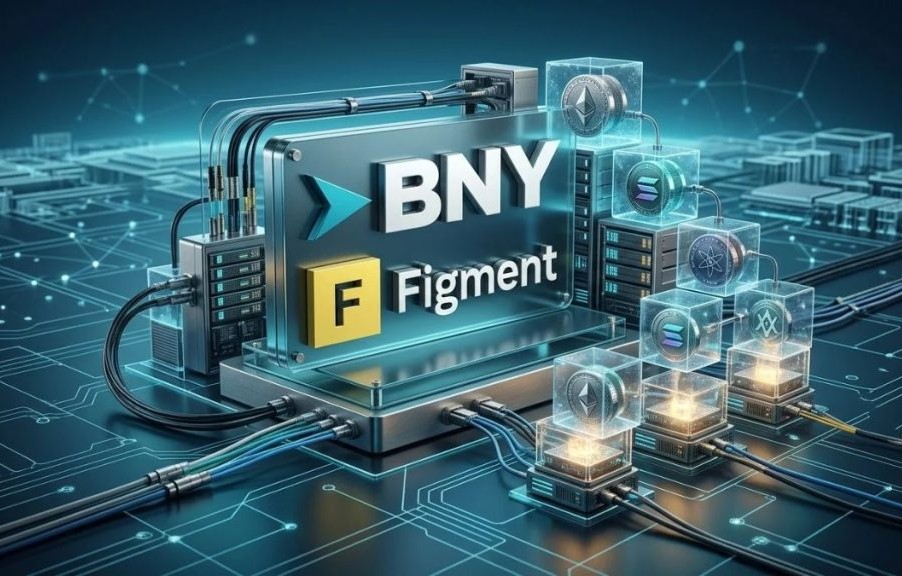
BNY (NYSE: BNY), one of the world’s largest financial services and custody institutions, has partnered with blockchain infrastructure provider Figment to introduce cryptocurrency staking capabilities through its existing Digital Asset Custody platform. The collaboration will allow eligible institutional investors, including asset managers, exchange-traded fund (ETF) issuers, corporations and wealth management firms, to earn blockchain staking rewards without establishing a separate custody relationship. Ethereum (ETH) will be the first supported cryptocurrency, with Solana (SOL) expected to follow. Figment will provide the validator infrastructure responsible for supporting staking operations, while BNY will maintain its institutional custody and asset-servicing framework. The announcement represents another significant development in Wall Street’s adoption of blockchain technology, expanding BNY’s digital asset business beyond cryptocurrency safekeeping into services that allow institutional clients to participate directly in proof-of-stake networks. Although the companies confirmed the partnership on Thursday, they have not announced an official launch date, staking yields or the amount of institutional assets expected to participate.
BNY Expands Digital Asset Custody Into Cryptocurrency Staking
BNY is taking another step toward integrating blockchain-based financial services into traditional institutional banking infrastructure.
The company announced on November 12 that it will work with Figment, a provider of blockchain validation and staking infrastructure, to support staking through BNY’s existing Digital Asset Custody platform.
The arrangement is designed to give institutions access to staking services without requiring them to manage the technical infrastructure involved in blockchain validation.
For asset managers and other regulated financial institutions, this approach could reduce the operational complexity of participating in proof-of-stake networks.
Rather than maintaining separate relationships with cryptocurrency custodians and staking providers, eligible clients would be able to access both services through BNY’s existing platform.
The partnership divides responsibilities between the two companies.
BNY will provide institutional custody, client servicing and the established operational framework through which customers manage their digital assets.
Figment will supply the validator infrastructure required to participate in supported proof-of-stake blockchain networks.
Key Details of the BNY–Figment Partnership
| Category | Details |
|---|---|
| Banking partner | BNY |
| Blockchain infrastructure provider | Figment |
| Service | Institutional cryptocurrency staking |
| Initial supported asset | Ethereum (ETH) |
| Planned additional asset | Solana (SOL) |
| Eligible customers | Asset managers, ETF issuers, corporations and wealth management firms |
| Custody platform | BNY Digital Asset Custody |
| Launch date | Not announced |
| Staking yields | Not disclosed |
The service is intended for eligible institutional clients rather than ordinary retail banking customers.
BNY has not announced that all existing custody customers will automatically receive staking access.
Availability may depend on client eligibility, supported assets, regulatory requirements and the final rollout of the service.
Ethereum Will Be First Cryptocurrency Supported for Staking
According to details provided by Figment, Ethereum will be the first cryptocurrency supported through the new staking arrangement.
Ethereum operates through a proof-of-stake consensus mechanism, which relies on validators to confirm transactions and help secure the blockchain.
Validators participate in the network by committing ETH and performing duties associated with transaction validation and block production.
In return, validators can earn rewards generated by the Ethereum protocol.
These rewards are variable and depend on network conditions, validator performance and other factors.
For institutional investors holding significant amounts of ETH, staking provides a potential opportunity to generate additional returns from assets already held in custody.
However, staking differs from traditional bank interest.
Rewards are generated through blockchain participation rather than through a conventional deposit account.
They are not guaranteed, and staking introduces risks that do not necessarily exist when assets are simply held without participating in network validation.
How Ethereum Staking Works
An institution holds ETH: An eligible client maintains supported digital assets through BNY’s custody platform.
The client elects to stake: Subject to eligibility and service availability, the institution authorizes participation in staking.
Figment provides validator infrastructure: Its technology supports the validation activities required by Ethereum.
Validators participate in network consensus: The infrastructure performs duties associated with securing the blockchain.
The protocol distributes rewards: Successful participation can generate staking rewards, subject to applicable fees and network conditions.
BNY provides institutional servicing: The bank supports the custody and client-service processes associated with the arrangement.
The structure is designed to make staking accessible through an institutional custody relationship.
However, keeping assets within a custody framework does not eliminate blockchain-specific risks or guarantee immediate liquidity.
Solana Staking Expected to Follow Ethereum
The partnership is also expected to support Solana (SOL) after the initial Ethereum rollout.
Solana is another major proof-of-stake blockchain, supporting decentralized exchanges, stablecoin payments, tokenized assets and other Web3 applications.
Like Ethereum, Solana uses validators to help secure its network.
SOL holders can delegate tokens to validators and potentially earn staking rewards.
However, Ethereum and Solana use different staking mechanisms, validator requirements and reward structures.
The differences matter for institutional investors evaluating the operational risks and liquidity characteristics of each network.
For example, Ethereum staking can involve validator activation and withdrawal queues, while Solana’s delegation and reward processes operate through its own epoch-based system.
The companies have not disclosed when Solana staking will become available through BNY.
They also have not announced whether additional proof-of-stake networks will be supported.
The initial focus on Ethereum and Solana reflects the importance of these networks within institutional digital asset markets.
Both ecosystems have attracted substantial development activity and growing interest from traditional financial institutions.
Figment Will Provide Validator Infrastructure for BNY Clients
The technical foundation of the partnership will be provided by Figment, a company specializing in institutional blockchain infrastructure.
Figment operates validator services that allow organizations to participate in proof-of-stake networks without independently maintaining all the necessary technical systems.
Validator infrastructure is essential because proof-of-stake networks depend on participants performing specific duties reliably.
These responsibilities can include validating transactions, proposing blocks and maintaining network availability.
Poor validator performance can reduce staking rewards.
Certain failures or violations of protocol rules can also result in penalties.
Figment’s role is to provide the technology and operational expertise needed to support those activities.
The company describes itself as a major noncustodial staking provider across Ethereum and Solana.
According to its reported business figures, Figment serves more than 1,500 institutional customers, including:
Asset managers seeking blockchain-based investment services.
Cryptocurrency exchanges offering staking functionality.
Custodians integrating staking into existing asset-management platforms.
Wallet providers supporting proof-of-stake participation.
Financial institutions exploring blockchain infrastructure.
The BNY agreement provides Figment with another opportunity to deliver staking technology through an established financial institution.
However, the companies have not disclosed the commercial terms of their arrangement.
BNY Says Institutions Want Staking With Stronger Oversight
The partnership reflects growing institutional demand for staking services delivered through familiar custody and operational structures.
Ralf Roth, Head of Digital Asset Custody at BNY, emphasized that institutional clients are increasingly focused on how staking services are provided.
For regulated institutions, the ability to earn rewards is only one part of the decision.
They must also evaluate security controls, reporting, governance, operational accountability and the ability to meet applicable regulatory obligations.
A financial institution may be comfortable holding cryptocurrency but unwilling to manage validator infrastructure directly.
BNY’s arrangement with Figment is intended to address that gap.
By integrating staking into an existing custody relationship, the bank aims to offer clients a more familiar framework for participating in blockchain networks.
The institutional advantages could include:
Integrated custody: Access to staking through an existing digital asset custody platform.
Operational efficiency: Reduced need to establish separate relationships with validator operators.
Specialized infrastructure: Access to Figment’s blockchain validation technology.
Institutional servicing: Support through BNY’s existing client-service model.
Additional asset utility: Opportunities to earn protocol rewards on eligible holdings.
Governance and oversight: A service structure designed around institutional requirements.
These benefits represent the intended design of the offering.
The actual experience will depend on the final implementation, client agreements and supported blockchain networks.
Why Staking Matters to Institutional Investors
Staking is becoming increasingly relevant as institutional investors expand their exposure to cryptocurrencies beyond Bitcoin.
Bitcoin uses a proof-of-work consensus mechanism and does not support native staking in the same way as Ethereum or Solana.
Ethereum and Solana, by contrast, allow eligible holders to participate in securing their networks through proof-of-stake mechanisms.
For institutions holding these assets, staking creates a potential additional source of return.
An asset manager that holds ETH for a long-term investment strategy may be interested in earning staking rewards rather than leaving the assets entirely inactive.
However, institutional staking involves several considerations that differ from conventional financial products.
Major Institutional Staking Considerations
| Consideration | Why it matters |
|---|---|
| Reward variability | Staking returns change with network conditions and validator performance |
| Validator risk | Operational failures may reduce rewards or create penalties |
| Liquidity | Staked assets may be subject to withdrawal processes or delays |
| Custody controls | Institutions must determine how assets are safeguarded and administered |
| Regulatory treatment | Staking eligibility and compliance obligations can differ by product and jurisdiction |
| Reporting | Investment managers need reliable records for accounting, auditing and client disclosures |
| Fees | Validator and servicing charges can reduce net rewards |
These considerations help explain why some institutions prefer to access staking through established financial service providers.
The BNY–Figment partnership is designed to combine specialized blockchain infrastructure with institutional custody practices.
ETF Issuers Could Benefit From Integrated Staking Services
One of the most important groups identified in the announcement is exchange-traded fund issuers.
Cryptocurrency ETFs have expanded institutional access to digital assets by allowing investors to purchase shares through conventional brokerage accounts.
However, staking introduces additional operational and regulatory questions for funds holding proof-of-stake cryptocurrencies.
An ETF issuer may need to determine whether its investment structure permits staking, how rewards should be treated and whether the process affects the fund’s liquidity requirements.
A fund must also consider whether staking could interfere with its ability to process investor creations and redemptions.
BNY’s planned offering could provide infrastructure for ETF issuers that are permitted to stake eligible assets.
The arrangement may help simplify the process by integrating custody and validator access.
However, the partnership does not automatically authorize every Ethereum or Solana ETF to participate in staking.
Individual funds must comply with their governing documents, applicable regulations and operational requirements.
The announcement also does not confirm that any particular ETF issuer has committed assets to the new service.
Nevertheless, the inclusion of ETF issuers among the intended clients illustrates the growing connection between traditional investment products and blockchain-native financial activity.
BNY Has Offered Cryptocurrency Custody Since 2022
The Figment agreement builds on several years of digital asset development at BNY.
The bank launched its Digital Asset Custody platform in October 2022, initially supporting Bitcoin and Ethereum for selected institutional customers.
The launch represented an important step in bringing cryptocurrency custody into the infrastructure of a major traditional financial institution.
Custody services allow clients to safeguard digital assets through a specialized provider rather than managing all private-key infrastructure themselves.
For institutions, this can be particularly important because digital asset holdings may involve significant security, operational and regulatory responsibilities.
Since introducing the platform, BNY has expanded its digital asset initiatives to include additional assets and services.
The partnership with Figment represents another stage of that expansion.
Rather than limiting its offering to holding cryptocurrency, the bank is moving toward a broader model in which clients can access blockchain-related services through existing institutional relationships.
BNY’s Digital Asset Expansion
| Date | Development |
|---|---|
| October 2022 | BNY launches digital asset custody supporting Bitcoin and Ethereum for selected clients |
| August 2026 | BNY announces a separate institutional staking collaboration with Galaxy |
| October 2026 | BNY expands its custody relationship with Ripple to include XRP and RLUSD |
| November 12, 2026 | BNY announces its collaboration with Figment for institutional staking |
| Future rollout | Ethereum staking expected first, followed by Solana |
The progression reflects the bank’s broader interest in serving institutional clients participating in blockchain-based financial markets.
BNY Previously Partnered With Galaxy on Staking Infrastructure
The Figment announcement follows an earlier institutional staking collaboration between BNY and Galaxy, announced in August 2026.
That agreement was also designed to combine institutional custody services with proof-of-stake infrastructure.
Galaxy was identified as a design partner supporting BNY’s broader digital asset platform.
At the time, BNY indicated that its planned staking offering and certain related infrastructure developments remained subject to regulatory review.
The November announcement adds Figment as another staking infrastructure partner.
However, BNY has not publicly explained how the two relationships will operate alongside each other.
The companies have not clarified whether Galaxy and Figment will support different blockchain networks, institutional customers or service requirements.
It is therefore premature to conclude that Figment has replaced Galaxy.
The two arrangements may serve different purposes within BNY’s broader digital asset strategy.
Further details will be necessary to understand how the partnerships fit together when the staking service becomes operational.
Ripple Partnership Expands BNY’s Stablecoin and XRP Custody Business
BNY’s latest agreement also follows an expansion of its relationship with Ripple.
In October 2026, the companies broadened their custody arrangement to include XRP and Ripple USD (RLUSD).
RLUSD is Ripple’s U.S. dollar-backed stablecoin.
The expanded relationship also included plans to allow eligible BNY clients to mint and redeem RLUSD through the bank.
These developments reflect a growing effort to connect traditional financial infrastructure with blockchain-based assets and payment systems.
The Ripple relationship focuses on custody and stablecoin-related services.
The Figment partnership focuses on staking supported proof-of-stake assets.
Together, they illustrate how institutional digital asset services are becoming more specialized.
Rather than offering a single cryptocurrency product, financial institutions are developing platforms that support multiple activities.
These may include custody, stablecoin servicing, tokenized asset management and participation in blockchain consensus.
The broader objective is to make blockchain-based financial services accessible through systems institutions already use.
Figment Previously Supported More Than $2 Billion in Coinbase Prime Staking
Figment has also established relationships with major cryptocurrency companies.
One of its most significant partnerships involves Coinbase Prime, Coinbase’s institutional brokerage and custody platform.
The companies began integrating Ethereum staking services in early 2024.
In October 2025, they announced an expansion of their relationship to support additional proof-of-stake networks, including Solana, Cardano and Sui.
At that time, the companies reported that their collaboration had facilitated more than $2 billion in staked assets.
The figure demonstrates Figment’s experience providing validator infrastructure through institutional service platforms.
However, the $2 billion total relates to the Coinbase Prime partnership.
It does not represent assets already committed to BNY’s newly announced offering.
BNY and Figment have not disclosed a projected staking volume for their collaboration.
The distinction is important because announced partnerships do not automatically translate into assets being staked or rewards being generated.
Actual adoption will depend on client demand and the service’s eventual rollout.
Staking Introduces Risks Beyond Traditional Cryptocurrency Custody
Although staking can generate protocol rewards, it introduces risks that are different from simply holding cryptocurrency.
When an institution holds ETH or SOL without staking, its primary concerns may include asset security, custody controls and market volatility.
Staking adds operational responsibilities associated with blockchain validation.
For Ethereum, validators can face penalties for certain failures, including more serious penalties known as slashing for specific protocol violations.
Validators may also experience reduced rewards if they fail to perform required duties.
Solana has a different staking architecture and reward structure.
The operational risks and available penalties therefore need to be evaluated separately for each network.
Institutions must also consider liquidity.
Depending on the blockchain and service design, unstaking assets may require a waiting period before they become available for transfer or sale.
These conditions can matter for investment funds that need to meet redemptions or other obligations.
Important Risks for Institutional Clients
Market volatility: ETH and SOL prices can decline even while staking rewards are being earned.
Validator performance: Technical failures can reduce expected rewards.
Protocol penalties: Certain networks impose penalties for specific validator behavior.
Withdrawal delays: Staked assets may not be immediately available.
Operational dependencies: Clients rely on the performance of custody and validator service providers.
Regulatory requirements: Staking arrangements may be subject to different rules depending on the investor and jurisdiction.
Variable returns: Protocol rewards are not guaranteed and should not be treated as fixed interest payments.
BNY’s custody infrastructure may help institutions manage certain operational responsibilities.
However, the partnership does not eliminate the risks associated with staking or cryptocurrency ownership.
Wall Street Banks Are Expanding Into Blockchain-Based Financial Services
The BNY–Figment partnership arrives during a broader expansion of blockchain services across traditional finance.
Major financial institutions are increasingly exploring cryptocurrency custody, stablecoin payments, tokenized securities and blockchain settlement systems.
The shift reflects growing interest in using distributed ledger technology for financial activities traditionally handled through conventional intermediaries.
BNY’s decision to add staking capabilities is particularly notable because staking represents active participation in blockchain infrastructure.
Traditional custody focuses primarily on safeguarding assets.
Staking introduces a service in which eligible assets can help secure a blockchain network and potentially generate rewards.
Other financial institutions are also expanding their digital asset capabilities.
Deutsche Bank announced the launch of its digital asset custody service in November 2026.
Morgan Stanley has been exploring tokenization of U.S. equities and Treasury securities through infrastructure associated with the Depository Trust & Clearing Corporation.
Meanwhile, cryptocurrency platforms and traditional banks are developing partnerships involving stablecoin payments and institutional custody.
These initiatives demonstrate how blockchain technology is becoming increasingly integrated into mainstream financial infrastructure.
However, the scale of actual adoption varies considerably between projects.
Announcements of new services do not necessarily indicate that significant transaction volumes or customer assets have already moved onto blockchain networks.
Institutional Staking Could Strengthen Ethereum and Solana Adoption
The inclusion of Ethereum and Solana in BNY’s planned staking offering could have broader implications for both blockchain ecosystems.
Ethereum is widely used for decentralized finance, stablecoins and tokenized assets.
Solana has attracted growing interest in payments, trading applications and institutional blockchain projects.
Staking is an important component of both networks because it helps support their proof-of-stake consensus systems.
If more institutional investors participate in staking, the networks could see increased involvement from traditional financial institutions.
However, the impact will depend on the amount of assets actually staked.
The companies have not disclosed expected client participation or staking volumes.
Institutional staking can also raise questions about validator concentration.
If a large proportion of staked assets is delegated to a small number of infrastructure providers, that concentration may influence the distribution of network validation responsibilities.
A healthy proof-of-stake ecosystem benefits from a diverse validator base.
For Ethereum and Solana, growing institutional participation therefore creates both opportunities and considerations involving network decentralization.
What Comes Next for BNY and Figment?
The companies have confirmed the partnership but have not announced when the staking service will become available.
Several important details remain unresolved.
Key developments to watch include:
Official launch date: When eligible BNY customers can begin staking through the platform.
Ethereum availability: Confirmation that ETH staking has become operational.
Solana integration: Timing for the planned addition of SOL.
Institutional participation: Whether asset managers, ETF issuers and corporations begin committing assets.
Staking fees: The charges associated with custody, validator infrastructure and servicing.
Reward reporting: How staking returns will be calculated and communicated to clients.
Regulatory status: Whether any outstanding reviews or approvals are required.
Galaxy relationship: How Figment’s role will coexist with BNY’s earlier staking collaboration.
These developments will provide a clearer picture of the partnership’s commercial and technical significance.
The initial announcement establishes the companies’ intentions, but the actual impact will become measurable only after the service is available and institutions begin using it.
BNY and Figment Partnership Marks Another Step Toward Institutional DeFi Adoption
The November 12 agreement between BNY and Figment represents another important development in the integration of traditional financial services with blockchain infrastructure.
By combining BNY’s institutional custody platform with Figment’s validator technology, the companies intend to make cryptocurrency staking more accessible to asset managers, ETF issuers, corporations and wealth management firms.
Ethereum will be the first supported cryptocurrency, with Solana expected to follow.
The service will allow eligible institutions to pursue staking rewards through an existing custody relationship rather than independently managing validator infrastructure.
The announcement builds on BNY’s digital asset custody business, launched in 2022, and its more recent partnerships involving Galaxy and Ripple.
It also expands Figment’s institutional presence following its previous work with Coinbase Prime and other financial service providers.
However, the companies have not disclosed a launch date, staking yields, expected assets or the complete operational terms of the offering.
Those details will determine how quickly the service can attract institutional participation.
BNY’s decision to integrate Figment’s staking infrastructure signals that major financial institutions are moving beyond simply holding cryptocurrency toward offering services that participate directly in blockchain networks. As Ethereum and Solana continue attracting institutional attention, the partnership could help establish staking as another component of mainstream digital asset custody and investment services.
- Bank of America Reveals XRP Exposure With 13,000 ETF Shares
- 1.6 Trillion BONK Tokens Worth $53.5 Million to Be Burned as Part of BURNmas
- JPMorgan to Let Institutional Clients Pledge BTC and ETH as Loan Collateral by Year-End
- Kekius Maximus ($KEKIUS) Drops 80% in Few Hours of Surge
- Bitcoin Rebounds to $97,500 After Post-Inflation Drop
- Bitcoin Dips Below $84,000 as Tech Stocks Slide and Commodities Whipsaw Markets