













































































































































































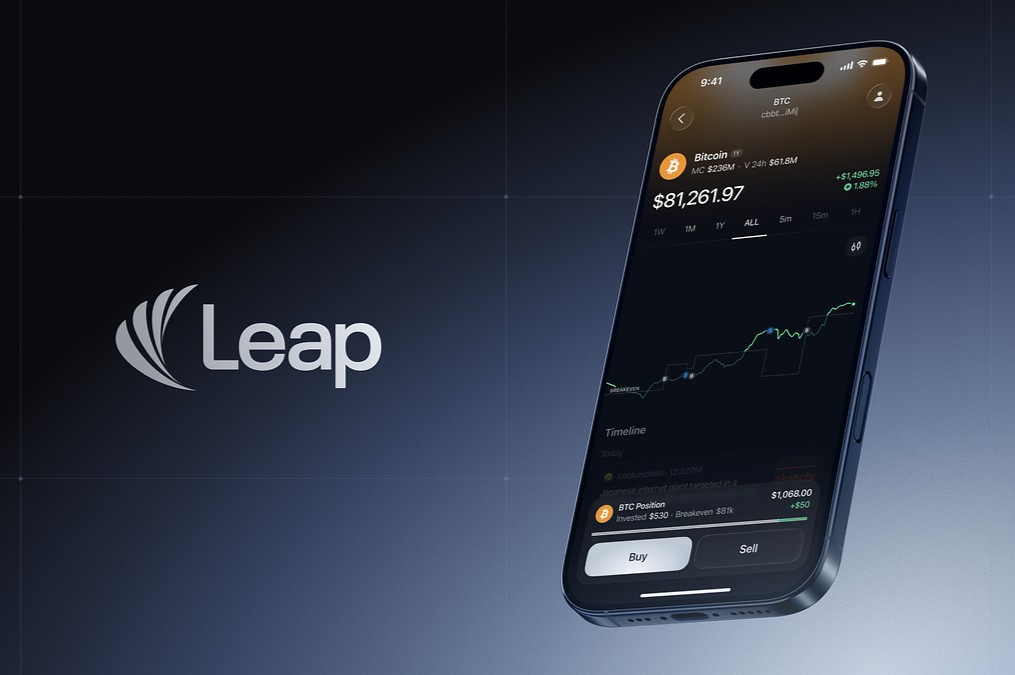
Solana Labs has officially launched Leap, a new mobile trading application that allows users to trade tokenized stocks, exchange-traded funds (ETFs), precious metals, currencies and cryptocurrencies through the Solana blockchain. Announced on November 5, 2026, the platform is available in beta for iPhone users through Apple’s TestFlight program, with an Android version planned for a future release. Developed by the team behind Dialect, which Solana Labs acquired earlier this year, Leap combines real-time market information, advanced profit-and-loss tracking and blockchain-based trading within a single application. The platform launches without its own trading fees and plans to use future revenue to buy and burn SOL tokens, while introducing a referral program that rewards early users. The initiative represents another major step toward bringing traditional financial assets and cryptocurrency trading together through decentralized blockchain infrastructure.
Solana Labs Introduces Leap as New Mobile Trading Platform
On November 5, Solana Labs, the technology company behind the development of the Solana blockchain, announced the beta launch of Leap, a mobile application designed to provide retail investors with access to multiple financial markets.
Unlike conventional cryptocurrency trading applications that focus primarily on digital tokens, Leap combines blockchain-based representations of traditional financial instruments with cryptocurrencies.
The platform supports trading across several asset categories, subject to regulatory and geographic restrictions:
Tokenized stocks: Blockchain-based products tracking the value of publicly traded company shares.
Exchange-traded funds: Tokenized products providing exposure to investment funds and market indexes.
Precious metals: Digital assets linked to commodities such as gold and other metals.
Currencies: Blockchain-based assets representing currency exposure.
Cryptocurrencies: Solana ecosystem tokens and other supported digital assets.
The application is designed to simplify access to blockchain-based financial markets by allowing users to manage different investments through one interface.
Anatoly Yakovenko, Co-Founder and CEO of Solana Labs, emphasized that the company’s next priority is developing applications that make blockchain technology more accessible.
Yakovenko explained that Solana’s infrastructure is increasingly capable of supporting a broad range of financial markets, making user experience and long-term engagement important areas of development.
The launch signals Solana Labs’ growing interest in building consumer-facing financial applications rather than focusing exclusively on blockchain infrastructure.
Leap Targets Long-Term Investors Instead of Memecoin Speculators
One of Leap’s primary objectives is to attract cryptocurrency investors interested in making informed financial decisions rather than pursuing short-term speculative trading.
Solana has become widely associated with memecoin trading, where digital assets can experience dramatic price increases and declines within relatively short periods.
Although memecoins have helped introduce new users to decentralized trading, their volatility and speculative nature have also raised concerns about investor losses and market manipulation.
Leap is positioning itself as an alternative for users who want to evaluate market conditions, monitor investment performance and manage positions over longer periods.
The company describes its approach as emphasizing trading discipline rather than encouraging users to execute large numbers of transactions.
This distinction is important because many trading platforms generate revenue from transaction activity, creating business incentives that can favor higher trading volumes.
Leap’s design places greater emphasis on helping investors understand how their portfolios are performing.
The platform also aims to make blockchain-based financial products more familiar to users accustomed to traditional investment applications.
By combining tokenized securities with cryptocurrency markets, Leap could appeal to investors seeking exposure to both asset classes without switching between multiple platforms.
Leap Integrates Market News Directly Into Trading Charts
A central feature of the new application involves connecting financial news with historical market movements.
Leap’s research team selects market-moving news stories and places them directly onto relevant asset price charts.
This allows users to examine how specific developments correspond with changes in market prices.
For example, a trader reviewing a tokenized technology stock could identify when an earnings announcement, regulatory decision or major corporate development occurred relative to the asset’s price movement.
The feature is intended to provide additional context beyond conventional price charts and technical indicators.
Rather than forcing users to search external websites for relevant market developments, Leap integrates selected news into the trading experience.
The platform also provides detailed profit-and-loss calculations that account for activity across a user’s trading history.
These calculations include deposits, withdrawals, transactions and associated fees.
By incorporating these costs, the application can estimate the actual breakeven price for each position.
This is particularly important for cryptocurrency traders because network fees, trading costs and multiple transactions can make it difficult to calculate investment performance accurately.
Leap’s approach is designed to provide a clearer picture of how much money users have gained or lost over time.
Jupiter, Helius and Birdeye Power Leap’s Trading Infrastructure
Leap operates through several established companies and protocols within the Solana ecosystem.
Rather than developing every component of its trading infrastructure independently, the application integrates services from existing blockchain technology providers.
Jupiter, one of Solana’s leading decentralized trading platforms, handles trade routing.
When users initiate a transaction, Jupiter helps identify available liquidity and execute the exchange through supported blockchain markets.
Helius provides blockchain infrastructure supporting the application’s connection to the Solana network.
The company specializes in tools that help developers build applications capable of interacting efficiently with blockchain transactions and data.
Birdeye supplies market data used to display asset prices and other trading information.
Together, these integrations allow Leap to provide trading execution, market analytics and blockchain connectivity within a single mobile interface.
Users enter the dollar amount they want to trade, and the application processes the transaction as an on-chain swap.
This differs from conventional stock brokerage systems, where trades generally execute through regulated securities exchanges and clearing infrastructure.
However, the availability of tokenized securities through Leap depends on the products offered by third-party issuers and applicable regulations.
Solana’s Alpenglow Upgrade Supports Faster Blockchain Transactions
The launch comes shortly after Solana introduced Alpenglow, a major upgrade to the blockchain’s consensus infrastructure.
According to Chris Osborn, General Manager of Leap and founder of Dialect, the upgrade has significantly reduced the time required for Solana transactions to reach confirmation.
Osborn stated that the network can now confirm transactions in approximately 150 milliseconds, a substantial improvement over its previous consensus system.
Faster confirmation times can improve the user experience for financial applications by reducing delays between initiating a transaction and receiving confirmation that it has been processed.
For trading platforms, network performance is particularly important because users expect transactions to execute quickly during periods of market volatility.
However, blockchain confirmation speed does not necessarily guarantee that every trade will execute at the exact price initially displayed.
Actual execution can also depend on market liquidity, routing conditions, transaction fees and price movements.
Leap’s developers believe that Solana’s improved performance provides the foundation for a trading experience capable of competing with more traditional financial applications.
The company is now focusing on developing the user-facing tools needed to make that infrastructure practical for everyday investors.
Solana Labs Acquires Dialect Team Behind Blinks and X Cashtags
Leap was developed by the team behind Dialect, a Solana-focused technology company acquired by Solana Labs earlier in 2026.
Dialect became known for developing Solana Actions and Blinks, technologies that allow users to interact with blockchain applications through shareable links.
Introduced in 2024, Blinks made it possible to initiate certain blockchain activities directly from supported websites and social media interfaces.
The technology helped demonstrate how cryptocurrency transactions could become more accessible without requiring users to navigate complicated decentralized applications.
Dialect’s team also contributed to the development of the cashtags feature on X, which connects financial symbols with market-related information.
Following the acquisition, the team began developing Leap as a new business operating under Solana Labs.
Chris Osborn, Dialect’s founder, now serves as Leap’s General Manager.
The acquisition reflects Solana Labs’ strategy of combining blockchain infrastructure with teams experienced in consumer application development.
By bringing Dialect’s expertise into the company, Solana Labs is attempting to improve how users interact with financial products built on its network.
Leap Plans to Buy and Burn SOL Using Future Trading Fees
One of the most notable aspects of Leap’s business model involves its proposed approach to transaction fees.
The platform is not charging its own trading fees during the initial beta launch.
However, users remain responsible for applicable blockchain network and trade-routing costs.
Leap plans to introduce platform fees in the future, although the company has not announced a specific fee schedule.
Once those fees are implemented, Leap intends to use a portion of the revenue to purchase and burn SOL, Solana’s native cryptocurrency.
A token burn permanently removes cryptocurrency from circulation by sending it to an address or mechanism that makes the tokens unusable.
Reducing the circulating supply can affect a cryptocurrency’s token economics, although it does not guarantee an increase in market price.
The proposed mechanism would connect a portion of Leap’s trading activity to demand for SOL.
However, the actual impact will depend on future trading volume, fee rates and the percentage of revenue allocated to token purchases and burns.
Because the platform has not yet introduced its own trading fees, the buy-and-burn program remains a future plan rather than an active source of token supply reduction.
Founders Club Offers 30% Referral Rewards to Early Users
Leap is also introducing a referral program designed to encourage early adoption.
Users who join the platform’s early waitlist may qualify for membership in the Founders Club, which provides referral-based rewards.
According to the company’s announcement, eligible members are expected to receive 30% of the trading fees generated by users they directly refer.
Participants may also receive an additional 5% of the trading fees generated by users referred through their initial referrals.
For example, if a Founders Club member invites another trader, the original member could receive a share of the platform fees generated by that person’s activity.
If the invited trader subsequently refers another user, the original member could qualify for an additional, smaller percentage of that user’s fees.
These rewards are subject to the company’s eligibility requirements and program terms.
Because Leap is not currently charging its own trading fees, the referral revenue model is expected to become relevant after platform fees are introduced.
The program could help the company attract new users while building a community around its trading application.
However, its long-term effectiveness will depend on user adoption, trading activity and the final fee structure.
Tokenized Stocks on Solana Face Regulatory Restrictions
Leap’s launch arrives as tokenized equities become an increasingly important segment of blockchain-based financial markets.
Tokenized stocks are digital assets designed to provide economic exposure to shares of publicly traded companies.
Depending on their structure, these products may represent direct ownership interests, claims against an issuer or synthetic exposure to an underlying security.
The legal rights associated with tokenized stocks can therefore differ significantly from those provided by traditional brokerage accounts.
Companies such as Securitize have expanded tokenized equity offerings involving major corporations, including Nvidia, Apple and Amazon, on the Solana blockchain.
However, the broader tokenized securities market continues to face regulatory challenges.
According to Decrypt, 56 companies had objected to having their shares traded through the planned tokenized stock venue being developed by OKX and Intercontinental Exchange (ICE).
These objections highlight concerns about how tokenized securities are issued, traded and regulated.
Leap’s tokenized stock and ETF offerings are also subject to geographic restrictions.
Tokenized securities are not available to U.S. persons or users in certain other restricted jurisdictions, even where other parts of the application may be accessible.
The application is also unavailable in the United Kingdom and additional restricted regions.
These limitations demonstrate that blockchain technology does not eliminate the securities laws governing traditional financial assets.
Leap Beta Available on iPhone With Android Launch Planned
Leap is currently available through Apple’s TestFlight program, allowing eligible iPhone users to participate in the beta testing period.
TestFlight is Apple’s official platform for distributing applications that are still undergoing development and testing.
The company plans to introduce an Android version, although a confirmed release date has not been announced.
Users interested in the application can also join the waitlist through the official website at leap.xyz.
The beta launch gives the development team an opportunity to evaluate trading performance, user experience and infrastructure reliability before expanding availability.
As with other early-stage financial applications, users should consider the potential risks associated with software still undergoing testing.
Blockchain transactions may be irreversible, and tokenized assets can involve additional risks related to smart contracts, market liquidity and third-party issuers.
The company’s geographic restrictions also mean that not every user will have access to the same investment products.
Leap Could Accelerate Solana’s Expansion Into Traditional Finance
The launch of Leap represents another step in Solana’s transition from a blockchain associated primarily with cryptocurrency trading into a broader financial infrastructure network.
By combining tokenized stocks, ETFs, commodities, currencies and digital assets within one application, Solana Labs is attempting to make blockchain-based markets more accessible to retail investors.
The platform’s integration with Jupiter, Helius and Birdeye demonstrates how established decentralized finance infrastructure can support consumer-facing financial products.
Meanwhile, its market news integration and detailed profit-and-loss tracking reflect an effort to make cryptocurrency trading more transparent and easier to understand.
The planned SOL buy-and-burn mechanism could also create a connection between the platform’s commercial activity and the network’s native cryptocurrency, although its economic impact remains uncertain.
For traditional finance, the application illustrates how tokenized securities could eventually be distributed through blockchain-based platforms rather than exclusively through conventional brokerage infrastructure.
However, regulatory restrictions, investor protections and the legal structure of tokenized assets remain important obstacles to widespread adoption.
As institutional asset managers and financial technology companies continue exploring tokenization, applications such as Leap could play an increasingly important role in connecting digital assets with traditional investment markets.
Solana Labs’ Leap launch demonstrates how the next phase of blockchain adoption may focus less on speculative cryptocurrency trading and more on building accessible financial applications that bring multiple asset classes together on-chain.
- Afroman’s Crypto Token Surges 4,685% After Defamation Trial Victory
- Bitcoin and Ethereum Post Worst Weekly Decline Since FTX Collapse as Crypto Market Loses $390 Billion
- NYSE Parent Firm ICE to Invest $2 Billion in Polymarket’s Prediction Platform
- Magic Eden Unveils Season 2 of ME Token Rewards
- Peter Thiel-backed crypto exchange Bullish formally files for IPO
- Coinbase Launches ‘Coin50’ Index as Crypto Equivalent to S&P 500 and a Balance to Bitcoin