






















































































































































































































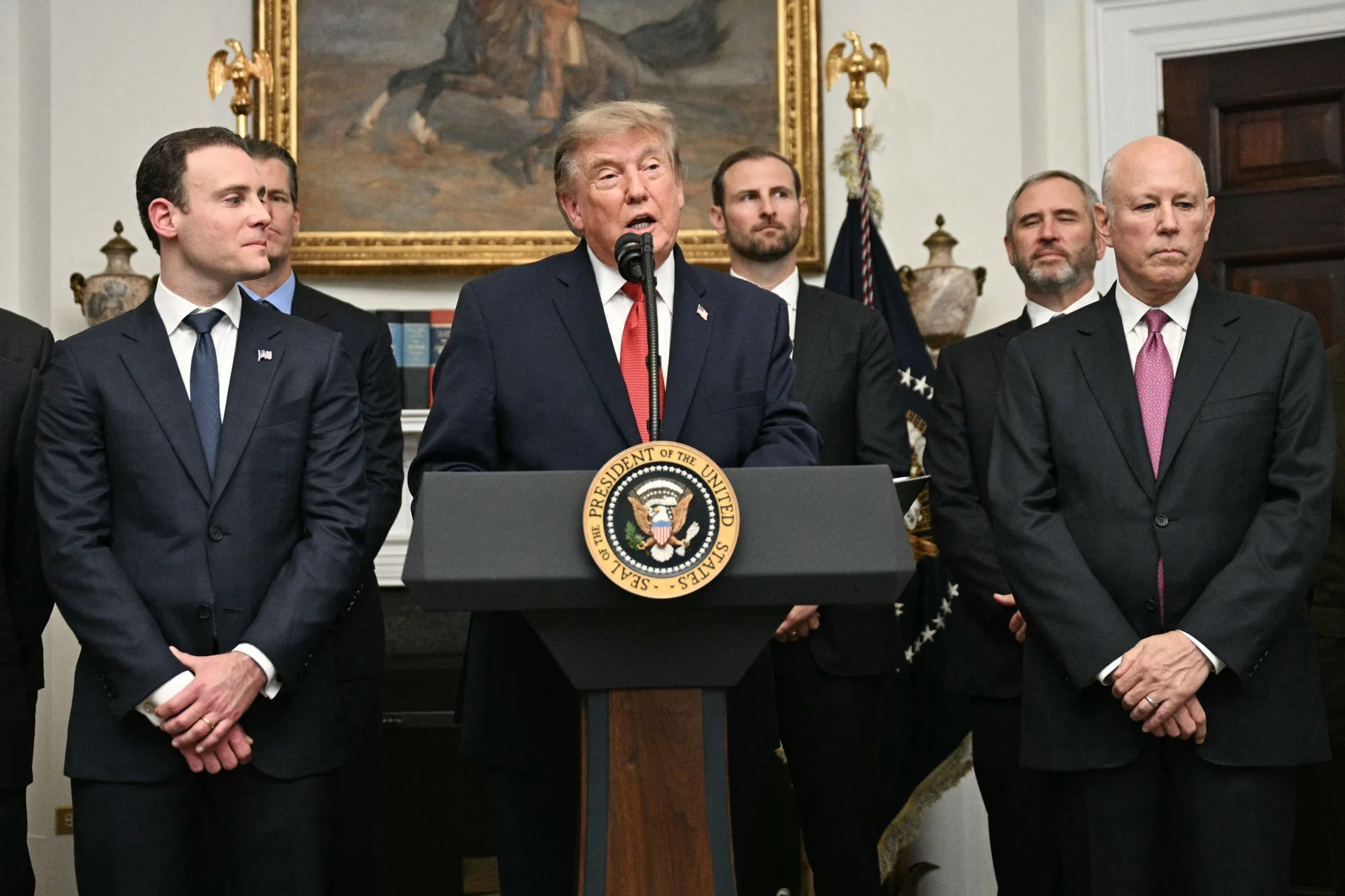
President Donald Trump is turning up the pressure on Congress to pass the CLARITY Act, bringing some of the biggest names in crypto and traditional finance to the White House as his administration pushes to establish a permanent regulatory framework for digital assets in the United States.
During a White House event Wednesday, Trump called on lawmakers to approve what he described as a “fair version” of the Digital Asset Market Clarity Act, arguing that comprehensive crypto legislation is the next major step toward making the United States a global leader in digital assets.
The event brought executives from Coinbase, Ripple, Robinhood, Kraken, Gemini, Nasdaq and Intercontinental Exchange together with senior federal regulators as Washington faces increasing pressure to determine how cryptocurrencies should be regulated.
Trump Says Congress Needs to Take the Next Step
Trump used the gathering to highlight the regulatory changes his administration has made since returning to office in January 2025, while arguing that executive and regulatory actions alone are not enough.
The president said Congress now needs to establish those changes in federal law through the CLARITY Act.
Trump argued that the legislation could help keep the United States competitive with China and other countries attempting to become leaders in blockchain and digital asset technology.
Some of the biggest goals of the CLARITY Act include:
- Establishing clearer definitions for digital assets
- Determining when a crypto asset should be treated as a security or commodity
- Dividing regulatory authority between the SEC and CFTC
- Creating federal rules for crypto exchanges and other digital asset platforms
- Providing greater legal certainty for companies building blockchain products in the United States
For the crypto industry, passing legislation is particularly important because regulatory policies established by individual agencies can potentially be reversed by future administrations or challenged in court.
Brian Armstrong Says Legislation Would Make Crypto Progress Permanent
Coinbase CEO Brian Armstrong joined Trump at the event and emphasized the importance of turning the administration’s current crypto policies into federal law.
Armstrong argued that passing the CLARITY Act would make the regulatory progress achieved under the Trump administration more durable and potentially allow the framework to remain in place for decades.
That has been one of the industry’s biggest priorities.
Crypto companies have spent years arguing that regulation through enforcement actions and changing interpretations from federal agencies created uncertainty for businesses operating in the United States.
A federal market structure law could give companies clearer rules for determining which regulator oversees their products before they launch them.
Crypto and Wall Street Executives Meet at the White House
The White House gathering included an unusually large group of executives from both the cryptocurrency industry and traditional financial markets.
Among those attending were:
- Coinbase CEO Brian Armstrong
- Robinhood CEO Vlad Tenev
- Kraken co-CEO Arjun Sethi
- Ripple CEO Brad Garlinghouse
- Gemini founders Cameron and Tyler Winklevoss
- Intercontinental Exchange CEO Jeffrey Sprecher
- SEC Chairman Paul Atkins
- CFTC Chairman Michael Selig
- White House crypto adviser Patrick Witt
The presence of executives from both crypto-native companies and traditional financial institutions highlighted how digital assets are increasingly becoming part of the broader U.S. financial system.
CLARITY Act Remains Stuck in the Senate
Despite Trump’s support and extensive lobbying from the crypto industry, the CLARITY Act still faces significant obstacles in Congress.
The House passed its version of the legislation in July 2025, but negotiations in the Senate have been considerably more difficult.
Senate leaders had hoped to advance the legislation before lawmakers left Washington for their August recess, but negotiations were pushed back amid disagreements over several provisions.
The limited congressional calendar means lawmakers now have a narrowing window to reach an agreement.
Trump’s Crypto Businesses Complicate Negotiations
One of the biggest disputes surrounding the legislation involves ethics rules for elected officials.
Democratic lawmakers and some Republicans have pushed for stronger restrictions preventing presidents, members of Congress and other senior government officials from financially benefiting from cryptocurrency ventures while holding office.
The debate has become particularly sensitive because of Trump’s family’s involvement with World Liberty Financial, along with crypto projects associated with the Trump name.
Reuters reported that Trump’s family crypto ventures generated more than $1.4 billion for the president in 2025. Trump has maintained that he does not participate in the day-to-day operations of his family’s businesses and that his investments are independently managed.
The dispute has become one of the major obstacles to finding enough bipartisan support for the legislation.
Ethics Enforcement Becomes a Major Sticking Point
Current proposals would prohibit certain senior federal officials, including the president, vice president, members of Congress and their spouses, from creating or sponsoring digital assets while serving in office.
However, lawmakers remain divided over who should enforce those restrictions.
Some Democrats have objected to giving the Department of Justice sole enforcement authority, arguing that state attorneys general should also have the ability to pursue violations.
Republican Senator Thom Tillis and Democratic Senator Ruben Gallego have worked on a potential compromise that would expand enforcement authority to state attorneys general.
Resolving that dispute could prove critical to securing enough votes for the legislation.
Trump Administration Continues Broader Crypto Regulatory Push
The White House event was not limited to the CLARITY Act.
It came as multiple federal agencies move forward with separate initiatives affecting digital assets.
The SEC recently proposed rules that could make it easier for certain crypto projects to issue tokens and raise capital without being subjected to the full securities registration process.
Meanwhile, the CFTC is exploring new approaches to crypto derivatives, decentralized markets and other blockchain-based financial products.
CFTC Chairman Michael Selig is also working on potential pathways for bringing platforms such as Hyperliquid and perpetual futures markets into the United States under a compliant regulatory framework.
Crypto Markets Rally Following Washington Developments
The combination of Trump’s CLARITY Act push and other developments in Washington contributed to renewed optimism across cryptocurrency markets.
Bitcoin surged above $70,000 following the White House event, reaching levels not seen since early June.
The rally was also supported by the U.S. Treasury’s decision to increase purchases of long-duration government debt, which helped push Treasury yields lower and encouraged investors to move back into risk assets.
Ethereum, Solana, XRP and other major cryptocurrencies also climbed, while shares of crypto-related companies including Coinbase, Strategy, Circle and Robinhood benefited from the improving market sentiment.
CLARITY Act Could Define the Next Era of U.S. Crypto Regulation
The stakes surrounding the CLARITY Act extend well beyond the current administration.
Federal legislation could establish a regulatory foundation that determines how exchanges, blockchain developers, token issuers and decentralized financial platforms operate in the United States for years to come.
The crypto industry has already secured several regulatory victories under the Trump administration, but those changes could remain vulnerable without congressional action.
Trump’s White House meeting made the industry’s next objective clear. After years of fighting over enforcement actions and regulatory jurisdiction, the focus has shifted toward getting comprehensive crypto market structure legislation across the finish line.
Whether Congress can resolve its remaining disputes over ethics, enforcement and regulatory authority will determine whether the CLARITY Act becomes the foundation of U.S. crypto policy or remains another major digital asset bill stalled on Capitol Hill.
- Canary Capital Registers Staked Injective ETF in Delaware
- BlackRock, Ark Slash Bitcoin ETF Fees Again Ahead of SEC Deadline
- Wyoming Tests Instant Payments with State-Issued Stablecoin on Avalanche-Based Hashfire
- Illinois May Become First U.S. State with an Official Bitcoin Reserve
- 21Shares Joins the Race to Launch an XRP ETF With SEC Filing
- Uniswap Labs Hit with $175K Fine by CFTC For DeFi Violations