




















































































































































































































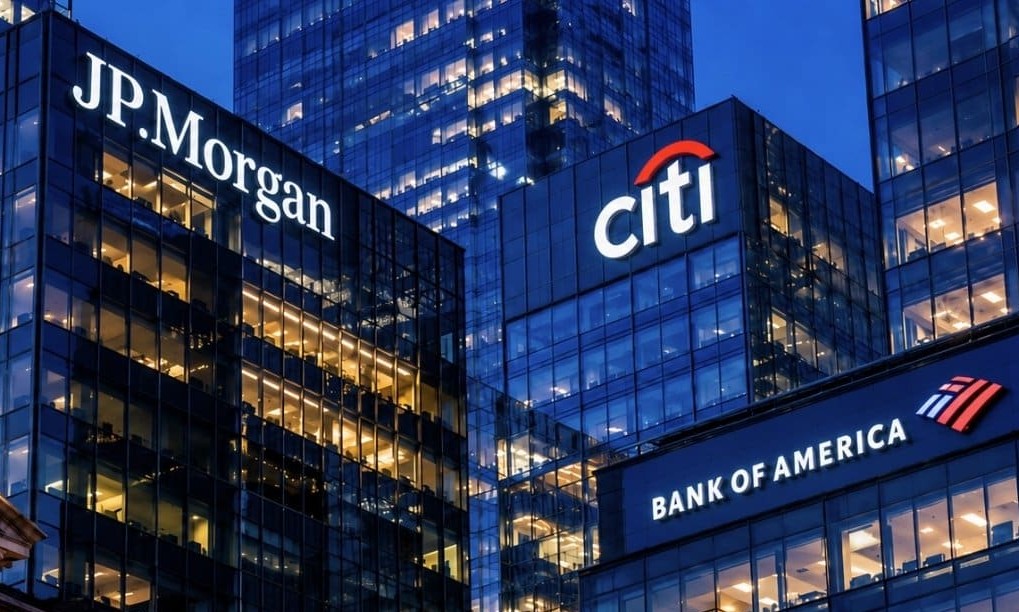
America’s largest banks are preparing one of the biggest blockchain initiatives in financial history. JPMorgan Chase, Bank of America, Citigroup, Wells Fargo, and several other major institutions are reportedly developing a shared tokenized deposit network designed to bring traditional bank deposits onto blockchain rails while competing directly with the growing stablecoin market. The project is expected to launch during the first half of 2027 through The Clearing House, a payments company jointly owned by many of the participating banks.
The initiative marks a significant shift in Wall Street’s approach to blockchain technology. Rather than treating stablecoins and crypto payment networks as external competitors, the banking industry is now building its own blockchain-based settlement infrastructure designed to keep deposits inside the regulated banking system while offering many of the same benefits that have fueled stablecoin adoption.
Banks Respond to the Stablecoin Threat
The project is widely viewed as a response to the rapid growth of stablecoins such as USDC and USDT, which have increasingly been used for payments, settlements, and treasury management. Bank executives have become concerned that widespread stablecoin adoption could eventually pull deposits away from traditional banks and into crypto-native financial ecosystems.
Unlike stablecoins, tokenized deposits are simply traditional bank deposits represented as blockchain-based tokens. Customers maintain their relationship with regulated financial institutions while gaining access to faster settlement and programmable payment capabilities. Because the deposits remain within the banking system, institutions can continue operating under existing regulatory, accounting, and risk-management frameworks.
The goal is to combine the speed and efficiency of blockchain technology with the trust and regulatory protections of traditional banking infrastructure.
How the Network Will Work
According to reports, the new platform will allow tokenized deposits to move between participating banks around the clock with near-instant settlement. The system is expected to support 24/7 payments, liquidity management, treasury operations, and cross-border transactions.
The network will be operated through The Clearing House, which already runs some of the most important payment infrastructure in the United States. While the blockchain provider has not yet been selected, participating banks are reportedly referring to the project internally as either “The Bridge” or “The Chain.”
One of the biggest advantages is the ability to settle transactions outside traditional banking hours. Instead of waiting for end-of-day processing or weekday settlement windows, tokenized deposits could move instantly at any time, including weekends and holidays.
Wall Street’s Tokenization Push Accelerates
The announcement comes as tokenization rapidly moves from experimentation to implementation across the financial industry. Major institutions including DTCC, Nasdaq, and large asset managers have spent the past year expanding tokenized securities, tokenized funds, and blockchain-based settlement infrastructure.
JPMorgan has already processed billions of dollars through its blockchain payment network, now known as Kinexys, while Citi has developed its own tokenized payment and treasury solutions for institutional clients. Bank of America recently created a dedicated digital asset transformation leadership role focused on tokenized deposits, stablecoins, custody, and blockchain infrastructure.
These developments suggest that major banks no longer view blockchain technology as a niche experiment but as a core component of future financial infrastructure.
Why This Matters for Crypto
Ironically, the banking industry’s blockchain offensive is being driven largely by crypto’s success. Stablecoins demonstrated that blockchain networks can move value globally, instantly, and around the clock. Rather than resisting that innovation, banks are now adopting many of the same concepts while attempting to maintain control of customer deposits.
For the crypto industry, the development is both validation and competition. On one hand, it confirms that blockchain-based settlement has become too important for major banks to ignore. On the other hand, tokenized deposits could compete directly with stablecoins for payments, treasury management, and institutional settlement activity.
The result could be a future financial system where traditional banks and blockchain networks increasingly operate side by side rather than in separate ecosystems.
The Bigger Picture
The planned tokenized deposit network represents one of the clearest signs yet that Wall Street is fully embracing blockchain technology. Instead of launching standalone cryptocurrencies, the nation’s largest banks are bringing traditional deposits onto blockchain rails while preserving the regulatory structure that governs the existing financial system.
- JPMorgan’s Blockchain Arm Kinexys Tests Tokenized Carbon Credits With S&P Global
- IBM Unveils Digital Asset Platform as Demand for Tokenization, Stablecoins Grows
- Mastercard Recruits Binance, Ripple and PayPal for New Crypto Partner Program
- UBS Trials Blockchain For Expanding Digital Gold Reach Geographically
- IBM Connects Banks to Swift Blockchain for Tokenized Deposit Payments
- BlackRock to Launch Tokenized Investment Fund on Ethereum, With Securitize



