
















































































































































































































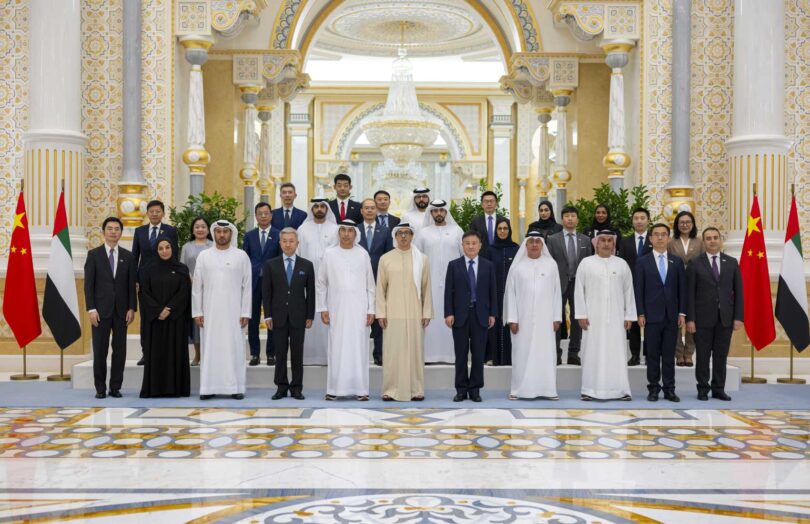
Officials from the United Arab Emirates and China met in Abu Dhabi to integrate the two nations’ payment infrastructures. This collaboration between the Central Bank of the UAE (CBUAE) and the People’s Bank of China (PBOC) aims to modernize financial systems. On November 19, Sheikh Mansour bin Zayed Al Nahyan, Vice President, Deputy Prime Minister, and Chairman of the Presidential Court, as well as Chairman of the CBUAE Board of Directors, launched the ‘Jisr’ project.
At the event at Qasr Al Watan, the first direct digital payment between the two nations was made, signaling the launch of the Jisr platform. Sheikh Mansour personally carried out the first interbank cross-border payment using Central Bank Digital Currency (CBDC) between the United Arab Emirates and China. The conference presented the expanded cooperation between the UAE and China, especially in the financial and technological spheres. Attendees included Pan Gongsheng, Governor of the People’s Bank of China; Khaled Mohamed Balama, Governor of the CBUAE; and Zhang Yiming, Ambassador of China to the UAE.
The initiatives come amid increasing efforts to develop financial infrastructures to accommodate the growing economic relationship between the two countries. The collaboration aims to create a secure, compliant, and efficient means of cross-border value transfer beyond traditional, legacy banking systems.
The three key aspects on which the framework introduced at the event rests are:
- Digital currency platforms,
- Interconnected payment systems,
- Consumer financial products.
The ‘Jisr’ platform involves several Emirati and Chinese commercial banks. Its main benefit is in cost reduction for cross-border transactions while offering real-time settlement capabilities, hence solving common frictions in international banking.
When interlinked, the UAE’s Instant Payment System and China’s Internet Banking Payment System create a safe corridor for the instantaneous transfer of cash 24 hours a day. The infrastructure is meant to support different uses, such as the transfer of scholarships for Emirati students studying in China, remittances from Chinese citizens residing in the UAE, and business deals between companies operating in both countries.
Thirdly, the issuing of the ‘Jaywan-UnionPay’ prepaid card is a very tangible consumer-facing result of such a strategy. The card, issued in cooperation with Lari Exchange, combines the UAE’s domestic card scheme, Jaywan, with China’s UnionPay. This means that when the card is used in the UAE, transactions are processed locally, while the cardholder will also have access to UnionPay’s wide international network that spans more than 180 countries.
In the future, the ‘Jisr’ platform will be further expanded by including more central banks in the network by 2026 to strengthen the UAE’s position in the global financial connectivity system. The goal is to foster innovation that encourages smooth cross-border payments, increasing stability between the two countries.
The officials revealed the launch of a new multi-scheme prepaid card, ‘Jaywan-UnionPay’, and signed a Memorandum of Understanding (MoU) committed to strengthening collaboration on cross-border payment solutions. Governor Khaled Mohamed Balama and Governor Pan Gongsheng signed an MoU to conclude the event.
Sheikh Mansour bin Zayed remarked that these projects represent new horizons for economic and technological cooperation and characterized the launching of the ‘Jisr’ platform and linking of systems for electronic payments as steps towards a state-of-the-art financial structure in support of world leadership in financial innovation.
- Bhutan Enables Crypto Payments for Tourism Services Through Binance Pay and DK Bank Partnership
- IMF to ‘Ensure’ That El Salvador Does Not Buy Any More Bitcoin
- Singapore’s DBS Bank to Offer Bitcoin & Ethereum Options Trading
- Chainlink Partners with Major Financial Players to Improve Corporate Actions Data Reporting Using AI and Blockchain
- Bank of England Softens “Overly Conservative” Stablecoin Rules After Industry Pushback
- Mercari to Launch Bitcoin Payments and XRP Trading in Japan